What drought tolerant means in the valley
A drought tolerant backyard here is one where the water goes only where it does something, and where every plant chosen can take both ends of our climate. That second part is what trips up designs copied from Southern California or Arizona. Fresno and Clovis get 105 degree afternoons in July and can drop to the high twenties on a January night, so a plant has to handle extreme heat, weeks of dry, and a real frost.
It also does not mean gravel and three yuccas. The best low water yards we build are green, layered and comfortable, they just spend their water carefully. The savings come from shrinking the irrigated area, grouping plants by need, delivering water at the root instead of through the air, and shading the ground so it stops evaporating. Done well, the yard looks fuller in August than a conventional landscape does, because nothing in it is struggling.
A drought tolerant backyard here is one where the water goes only where it does something, and where every plant chosen can take both ends of our climate. That second part is what trips up designs copied from Southern California or Arizona. Fresno and Clovis get 105 degree afternoons in July and can drop to the high twenties on a January night, so a plant has to handle extreme heat, weeks of dry, and a real frost.
Plants that take a valley summer and a valley winter
There is a long list of plants that thrive on very little water here once established. Crape myrtle gives you a small flowering tree that laughs at July. Chinese pistache and Chinese elm deliver real canopy and fall color. Texas ranger, rockrose, rosemary, lavender, Russian sage, dwarf oleander, bottlebrush and salvias fill the shrub layer. Ornamental grasses like deer grass and muhly move in the evening breeze and ask for almost nothing.
Natives hold up well because they evolved in this valley and foothill climate: toyon, ceanothus, manzanita, coffeeberry, California fuchsia and buckwheat. For accent, agave, aloe and yucca give structure, and because we do get frost, they belong in well drained spots rather than in a low corner that stays wet. Redbud, desert willow and Texas mountain laurel round out the small tree list for a yard that wants flower color without a water bill attached to it. All of them take our heat and shrug off a frosty Friant morning.
Established is the key word. Even a tough drought tolerant shrub needs regular water in its first summer while it puts roots down. Plant in fall if you can. The winter rain does part of the work for you and the plant enters its first July with a real root system. Expect to water new plantings regularly through that first season in Fresno or Selma, then taper off as the roots find their own moisture.
- Trees: crape myrtle, Chinese pistache, Chinese elm, desert willow, olive
- Shrubs: Texas ranger, rockrose, rosemary, bottlebrush, dwarf oleander, salvia
- Natives: toyon, ceanothus, manzanita, coffeeberry, California fuchsia
- Grasses: deer grass, muhly, blue fescue, feather grass
- Accents: agave, aloe and yucca, planted where drainage is good
Hydrozoning, the idea that saves the most water
Hydrozoning means grouping plants with similar water needs onto the same irrigation valve, so each zone runs exactly as long as its plants need instead of as long as the thirstiest plant in the yard needs. Most valley yards we inherit have one valve running a rose, a hydrangea, a mature shade tree and a strip of lavender, which guarantees that three of those four are wrong. Splitting that one valve into three is usually the cheapest water saving move available to an existing yard.
In practice the yard splits into a few clear zones. A small high water zone near the patio where you actually see the plants. A moderate zone of flowering shrubs. A low zone of natives and established trees that get deep, infrequent soaks. And a no water zone of decomposed granite, gravel and hardscape. The plan then puts the zones where they make sense: high water near the house and the seating, low water at the perimeter.
Sun exposure gets zoned too. The west facing side of a Fresno backyard is a fundamentally different climate from the shaded north side, and putting them on one valve wastes water on one side and starves the other. The same applies to a bed tucked under a wide eave, which gets almost no rain, and a bed in the open that gets all of it. We zone by what the plant actually experiences rather than by which side of the yard it happens to sit on.
- Group plants by water need and by exposure, not by where they look nice
- Separate valves for trees, shrubs, accents and any remaining lawn or turf
- High water plants close to the house where you see them daily
- Deep and infrequent for trees, shallow and frequent for new plantings
- Seasonal controller adjustments rather than one setting all year
Drip irrigation, and what goes wrong with it
Drip puts water at the root zone with almost no evaporation, which is exactly what you want when the air temperature is 105 and the wind is moving. It is also the only practical way to run a mixed planting design well, because emitters can be sized per plant. A pressure regulator and a filter at the valve are not optional here, and a good controller with seasonal adjustment does more for your water bill than any single plant choice.
The failures are predictable and fixable. Emitters clog, so the system needs a flush point and an annual look. Lines get buried under mulch and then cut by a shovel, so they should be mapped. Emitters stay six inches from a trunk while the plant grows into a four foot shrub, so they need to move outward over time. And drip is invisible, which means a broken line can run for weeks before anyone notices unless someone checks it seasonally.
Where there is still a turf or grass panel, keep it on its own valve entirely. Spray heads and drip should never share a zone. Spray and drip apply water at completely different rates, so a zone carrying both will always be wrong for one of them. Keeping them separate also lets the controller run the lawn on the schedule the city sets while the planting beds run on their own.
Want your yard priced?
Free estimate, we walk it with you.
Decomposed granite, gravel and mulch
Ground cover material does more work than people expect. Bare soil in a Fresno July bakes, cracks and loses whatever water reaches it. A few inches of mulch over a planting bed keeps the root zone cooler, holds moisture and suppresses weeds, and it is the cheapest improvement available to almost any yard. It also keeps soil temperature down around shallow roots, which matters more in a Fresno July than almost anything else you can do for a plant.
Decomposed granite is the valley workhorse for paths and seating areas. Compacted, and stabilized where it needs to hold a firm edge, it gives you a warm, natural walking surface at a fraction of the cost of paving, and it drains. Gravel and cobble work well in dry creek lines and around accent plantings. The one caution is heat: a large expanse of light gravel in full sun reflects a lot of it back at you, so it belongs in measured areas rather than wall to wall.
Steel, concrete or paver edging keeps all of it where it belongs, which is the difference between a crisp design and granite spread across the patio by October. Edging is what gives the design its lines, separating a granite path from a planting bed or a turf panel cleanly. We pour concrete mow strips and header curbs for exactly this, set at a height a mower, a hose and a wheelbarrow all pass over without catching.
- Two to three inches of mulch over every planting bed
- Compacted decomposed granite for paths and casual seating areas
- Stabilized DG where it meets a door, a patio or a slope
- Gravel and cobble in dry creek lines that double as drainage
- Real edging so materials stay separated
Shade is the cheapest cooling there is
Nothing lowers the water demand and the temperature of a valley backyard like shade. A shaded planting bed loses far less moisture than one in full sun. A shaded patio is usable at five in the afternoon in July, which is the whole point of having one. And a shaded west wall lowers what your air conditioner is fighting inside the house. It is the one improvement that pays you back in water, in comfort and on the power bill at the same time.
Shade comes from two directions. Trees are the long game: a crape myrtle, pistache or desert willow planted now is doing serious work in five years. Structures are the immediate answer: an attached patio cover, a freestanding cover over a seating area away from the house, a pergola with a louvered top, or a California room. We build those, wired for fans and lighting, on footings poured by our own crew.
The combination is what works. Structure over the patio for shade today, trees placed for shade in a decade, positioned on the west and southwest where the afternoon sun actually lands. Plant the tree when the structure goes up, and within a few summers the yard has two layers of shade instead of one. That is how a Clovis backyard ends up comfortable in July without running misters all afternoon.
Balancing hardscape and planting
A low water yard still needs surfaces to live on. The balance we aim for is enough hardscape to hold the furniture, the kitchen and the traffic paths, then planting everywhere else so the yard stays green and cool rather than turning into a heat sink. All hardscape reflects heat and feels harsh. All planting means more water and more maintenance. The middle is where the good yards sit. Roughly half and half is a sensible starting point for most valley yards, then adjust for how you use it.
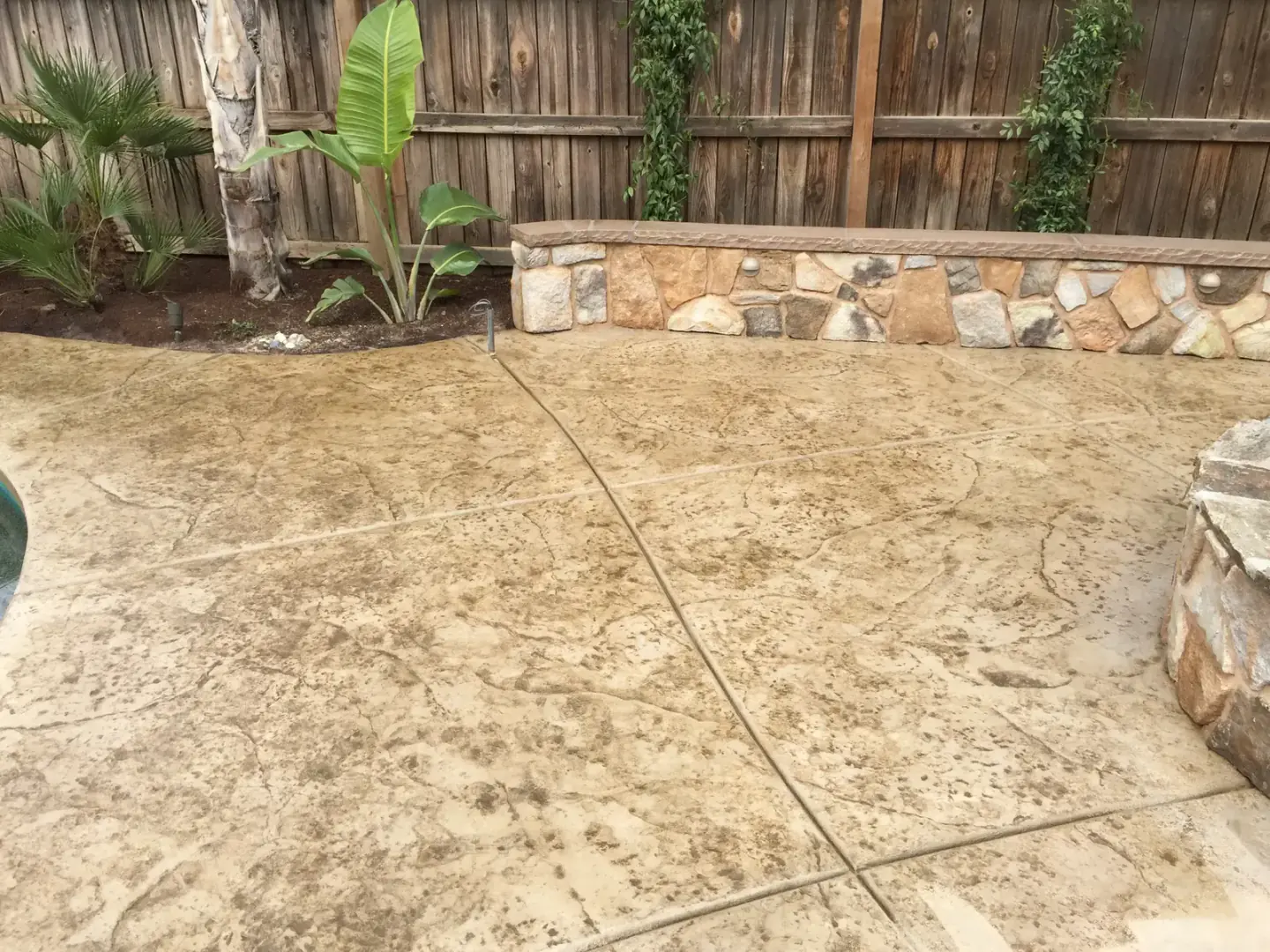
Concrete carries most of that load, sloped so irrigation and rain run into the planting rather than standing on the slab. Color choice matters in this climate too, because a lighter tone stays noticeably cooler underfoot than a dark one in a Madera or Visalia July.
Pavers, decomposed granite and turf fill in around it. Salas Outdoor designs and builds all of it with one crew, which is why the drainage, the irrigation and the flatwork actually agree with each other. The owner will come out, walk the yard and price it, often the same day you call or within 24 hours if it is not a weekend. Estimates are free, and you get a written price for the whole plan even if you build it across two or three seasons.
- Hardscape sized to furniture and traffic, not to fill the yard
- Lighter concrete tones where bare feet land in summer
- Slope the flatwork so runoff feeds the planting beds
- Keep a shaded green area, even in a very low water design
- Plan irrigation, drainage and flatwork at the same time
Questions we get about this
The follow ups this subject raises once somebody starts pricing it for real.
Will a drought tolerant yard look bare or gravelly?
Only if it is designed that way. The low water yards we build are layered and green: small flowering trees for canopy, a shrub layer with real color, ornamental grasses for movement, and mulch instead of bare dirt. Gravel and decomposed granite are used in measured areas for paths and accents. The water savings come from zoning, drip and shade far more than from removing plants.
When is the best time to plant a low water landscape in Fresno?
Fall, by a wide margin. Planting in October or November lets roots establish through the cool months with help from winter rain, so the plant enters its first July with a real root system underneath it. Spring planting works too with more attentive summer watering. Planting in mid summer is possible but it is the hardest path for both you and the plant.
How much water does drip actually save?
The savings come from three things together, and drip is one of them. Drip delivers water at the root with very little lost to evaporation and wind, hydrozoning stops you watering everything on the thirstiest plant's schedule, and mulch and shade keep what you applied in the soil. Shrinking the irrigated lawn area is usually the single largest change on a valley water bill.
Salas Outdoor
Written by the crew that does the work. Family owned since 1980, backyard remodeling and concrete across Fresno, Clovis and the Central Valley.