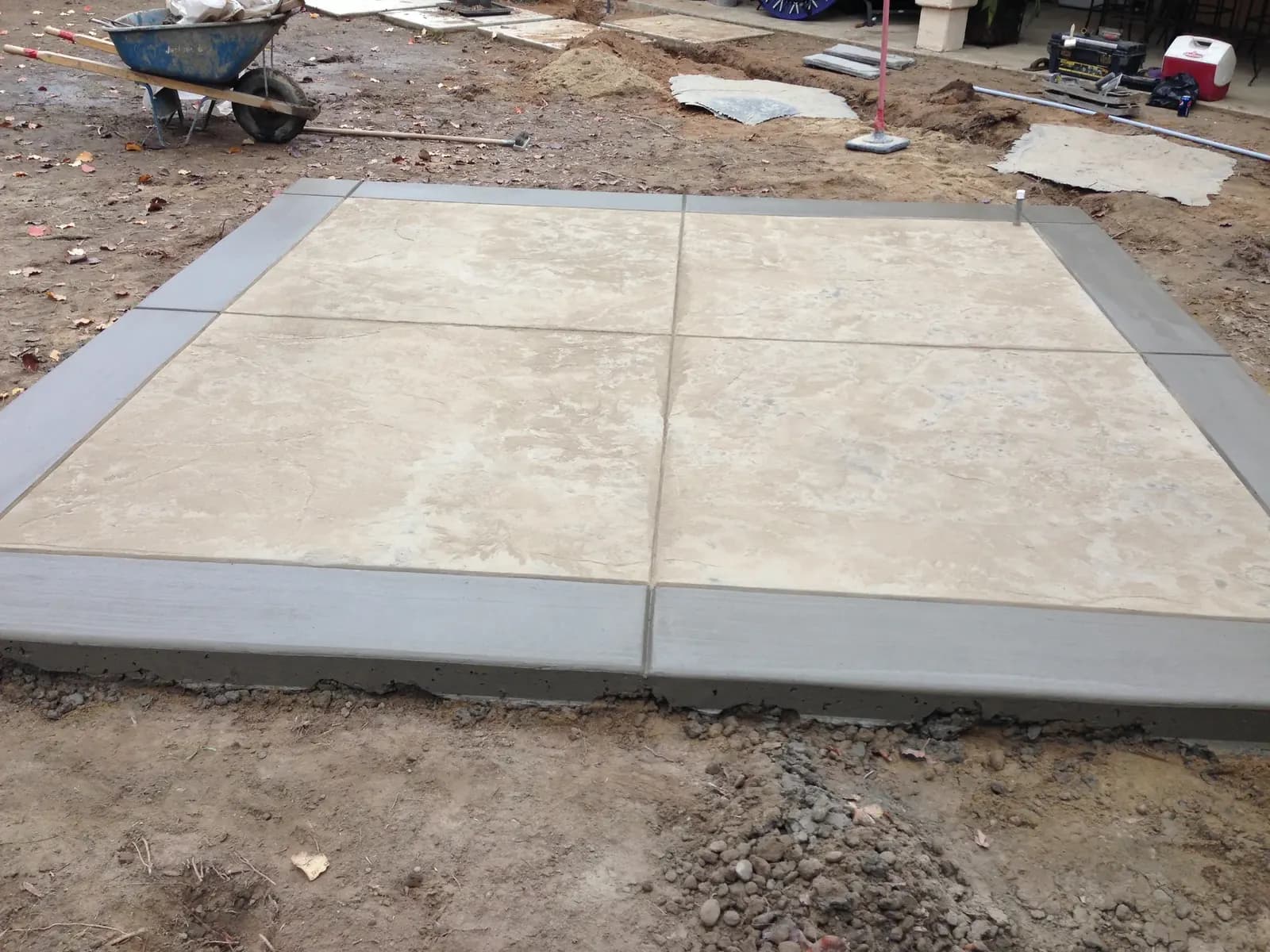
What a concrete driveway costs in the Central Valley
As of 2026, a new concrete driveway across Fresno, Clovis, Madera and the surrounding towns runs about $10 to $15 per square foot in a broom finish, and about $18 to $26 per square foot stamped and colored. A typical two car driveway of 600 square feet therefore lands near $6,000 to $9,000 broom finished. Tear out and haul off of the old driveway adds roughly $3 to $6 per square foot on top of that.
Those numbers sit above patio pricing for a reason, and it is not a markup. A driveway carries vehicle loads, so it is poured thicker, reinforced heavier and built on a subgrade that has been prepared to take weight rather than foot traffic. A written estimate is the only number worth acting on, and ours is free. The owner measures the drive himself, and homeowners here can usually get that visit the same day, or within 24 hours if it is not a weekend.
- Broom finish driveway: about $10 to $15 per square foot
- Colored or decorative saw cut: about $13 to $19 per square foot
- Exposed aggregate: about $14 to $20 per square foot
- Stamped and colored: about $18 to $26 per square foot
- Removing the old driveway: about $3 to $6 per square foot
- RV pad or parking apron, poured thicker: add about $1 to $3 per square foot
As of 2026, a new concrete driveway across Fresno, Clovis, Madera and the surrounding towns runs about $10 to $15 per square foot in a broom finish, and about $18 to $26 per square foot stamped and colored. A typical two car driveway of 600 square feet therefore lands near $6,000 to $9,000 broom finished. Tear out and haul off of the old driveway adds roughly $3 to $6 per square foot on top of that.
Thickness and steel, and why a driveway is not a patio
A patio at four inches with a mesh or a light rebar mat is fine because the heaviest thing on it is a table full of people. A driveway sees a loaded truck, a trailer tongue, a delivery van turning on the same square foot every week, and in the valley it sees all of that on a slab that expands and contracts through a 105 degree summer and a foggy winter. So the standard we pour is five inches with a proper grid of rebar tied and chaired, and more than that where an RV, a boat or a work truck lives on it.
That difference is most of the cost gap between a driveway and a patio of the same size. It is also the difference between a driveway that is still flat in twenty years and one that shows tire path cracking by year five. Reinforcement does not stop concrete from moving. It holds the slab together when it does, which is what keeps a hairline from opening up into a trip edge.
Hardpan, subgrade and what happens before the pour
Central Valley hardpan is a dense cemented layer that sits close to the surface across a lot of Fresno and Clovis, and it cuts both ways. It is a strong base once it is reached and compacted properly, and it is a problem when water cannot get through it and sits under your slab instead. Expansive clay shows up in other pockets, out toward Sanger, Selma and Fowler, and clay that swells when wet and shrinks when dry will lift a poorly prepared driveway all by itself.
So the base work is job specific. We excavate to depth, deal with whatever the dirt actually is rather than what we hoped it would be, bring in and compact base rock where the native material will not do the work, and get the compaction right before a form goes in. Roots from mature valley landscaping come out at this stage too, along with a root barrier where a tree is going to keep growing toward the new drive. It is the least visible money you will spend and the most important.
- Excavation to depth and removal of the spoil
- Compaction of native subgrade, or imported base rock where it will not compact
- Root removal and root barrier where mature trees threaten the slab
- Five inch minimum thickness with tied and chaired rebar
- Thicker sections where an RV, trailer or work truck parks
Tearing out what is already there
Most driveway jobs in established Fresno and Clovis neighborhoods are replacements, and the old drive has to come out. The cost of that depends on thickness, whether the original pour was reinforced, and how much of it a machine can reach. An unreinforced four inch drive on an open lot breaks out fast. A six inch reinforced slab that runs tight against a block wall, a gas meter and a neighbor's fence takes hand work and takes longer.
It is also the moment to fix whatever killed the old one. If a tree lifted it, the roots come out and a barrier goes in. If water ran toward the garage, the new grade gets corrected rather than copied. If a section failed and the rest is sound, we will tell you that too, because a partial replacement with a clean saw cut joint is sometimes the honest answer and it is a much smaller number.
- Breaking out and hauling an old drive: about $3 to $6 per square foot
- Reinforced or extra thick slabs cost more to remove than plain ones
- Work tight against block walls, meters and fences means hand labor
- Roots out and a root barrier in, where a tree caused the original failure
- Partial replacement with a clean saw cut joint, where only a section has gone
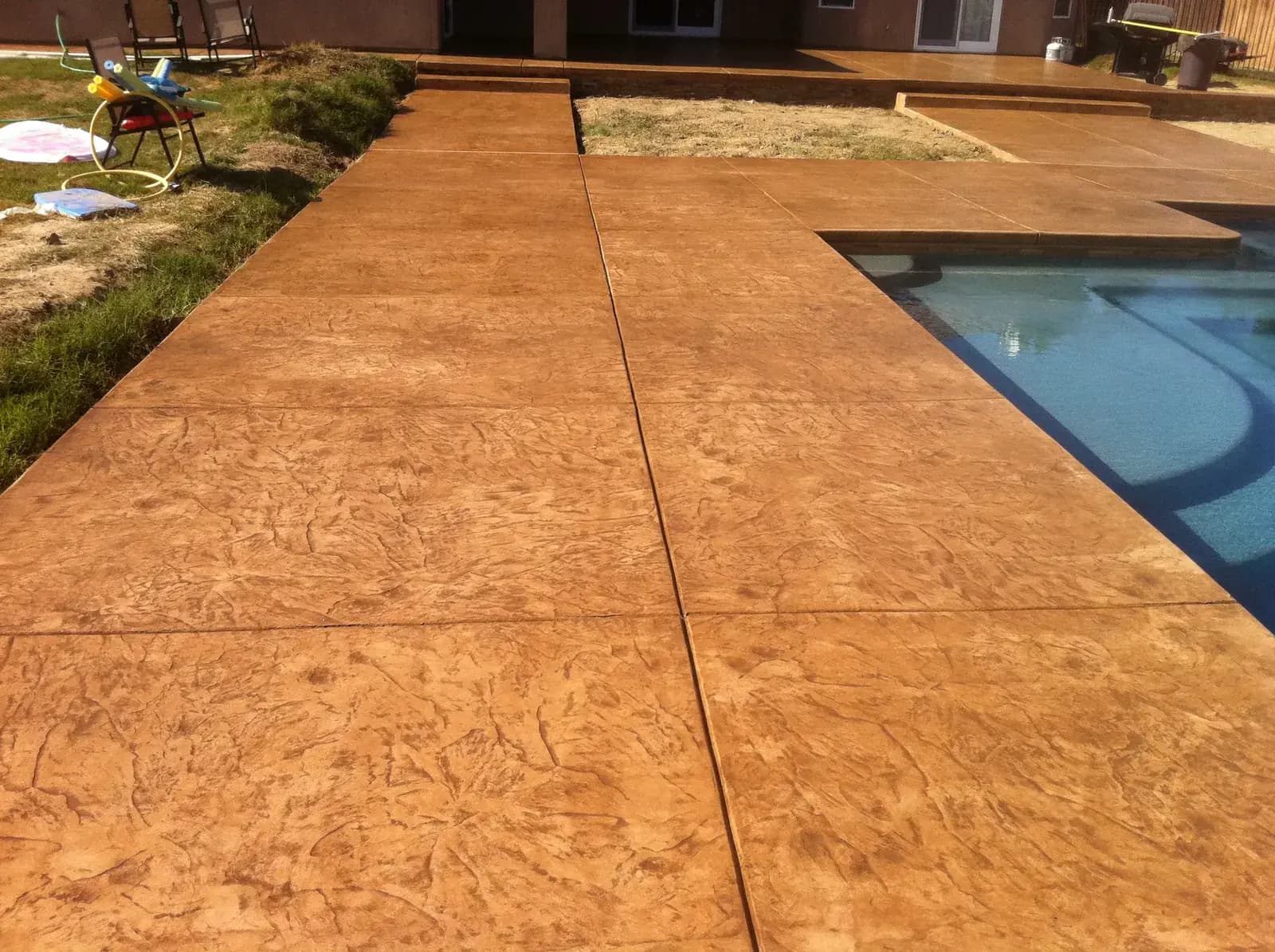
Want your yard priced?
Free estimate, we walk it with you.
Finishes, and what makes sense on a driveway
Broom finish is the right default for a driveway in this climate. It grips when it is wet or foggy, it hides tire marks better than a polished decorative surface, and it costs the least. A saw cut pattern, a color band at the border, or a stamped apron at the street end gives you most of the visual upgrade for a fraction of what stamping the whole drive costs.
Stamped driveways do look excellent, and they are the single most requested upgrade we quote in newer neighborhoods around Clovis and Madera. They need sealing every few years to hold color under valley sun, and a sealed stamped surface is slicker than broom finish when wet, which is worth thinking about on a sloped approach. Exposed aggregate splits the difference: no sealing schedule to speak of, excellent grip, and the natural stone look that has aged well on valley driveways for decades.
The approach, the city, and the part in the public right of way
The piece between your property line and the street belongs to a different set of rules. Fresno and Clovis both treat the driveway approach, the curb cut and any sidewalk crossing as work in the public right of way, which means an encroachment permit and an inspection, and a spec for thickness and slope that the city sets rather than you. Madera, Sanger and Kerman each have their own version of the same thing.
We handle that paperwork as part of the job and we build the approach to whatever the local standard says, because a failed inspection at the end is the most expensive kind of surprise. If your project widens the drive or moves the curb cut, that is a separate approval and we will tell you before you commit to the layout, not after. Sanger, Selma and Fowler run the same process with different counter hours, and we deal with all of them often enough to know what each one wants to see on the application.
Drainage, and where the water actually goes
A driveway is a large impermeable surface pointed at your house, so slope gets planned before the pour, not adjusted afterward. Water has to leave the garage door, not gather at it, and it has to get to the street or to a drain without crossing a neighbor's property. Where a drive sits below the garage slab, a trench drain across the apron is usually the answer and it belongs in the estimate from day one.
Control joints go in on a spacing set by the thickness, and expansion material goes where the drive meets the garage slab, the walkway and the approach, so the slab has somewhere to move when July does what it does. Before we finish, we check the surface for standing water and correct anywhere it collects, the apron, the side yard, wherever the new drive meets an existing walkway, because those junctions are where water usually finds a low spot.
What the written estimate covers
Where the price genuinely moves is the mix and the day it goes down. A higher strength mix, fiber in the load, or an admixture that holds the working window open on a 105 degree afternoon each add a little per yard, and each is cheaper than a driveway that had to be finished in a hurry.
The estimate is free, written, and covers all of it in one clear price: demolition, base work, thickness, steel, finish, drainage, and any permit work. The owner does the walk himself, usually the same day or within 24 hours if it is not a weekend. If the finished job uses less footage than we allowed for, that money goes back to you, which is something our customers have written reviews about. The family has been pouring valley concrete since April 1980 and the Google rating is 5.0 across 29 reviews. Send the form and we will come measure it.
Questions we get about this
The follow ups this subject raises once somebody starts pricing it for real.
How much does it cost to replace a two car driveway in Fresno?
For roughly 600 square feet in 2026, budget about $6,000 to $9,000 for a new broom finish drive, plus roughly $1,800 to $3,600 to break out and haul away the old one. Stamped and colored moves the pour itself closer to $11,000 to $15,600. Access, subgrade and any approach work in the city right of way shift it from there, so get it in writing.
How thick should a concrete driveway be in the Central Valley?
Five inches with a tied rebar grid is our standard for a residential drive here, and more where an RV, trailer or loaded work truck parks regularly. Four inches is a patio spec. The extra inch and the steel are a small part of the total cost and they are the difference between a driveway that lasts decades and one that shows tire path cracking within a few years.
Do I need a permit for a new driveway?
For the portion on your own property, usually not. For the approach, the curb cut and anything crossing the public sidewalk, Fresno, Clovis, Madera and the surrounding cities require an encroachment permit and an inspection, and they set the thickness and slope. We pull that paperwork and build to the local standard as part of the job, so nothing gets flagged after the concrete is down.
Salas Outdoor
Written by the crew that does the work. Family owned since 1980, backyard remodeling and concrete across Fresno, Clovis and the Central Valley.