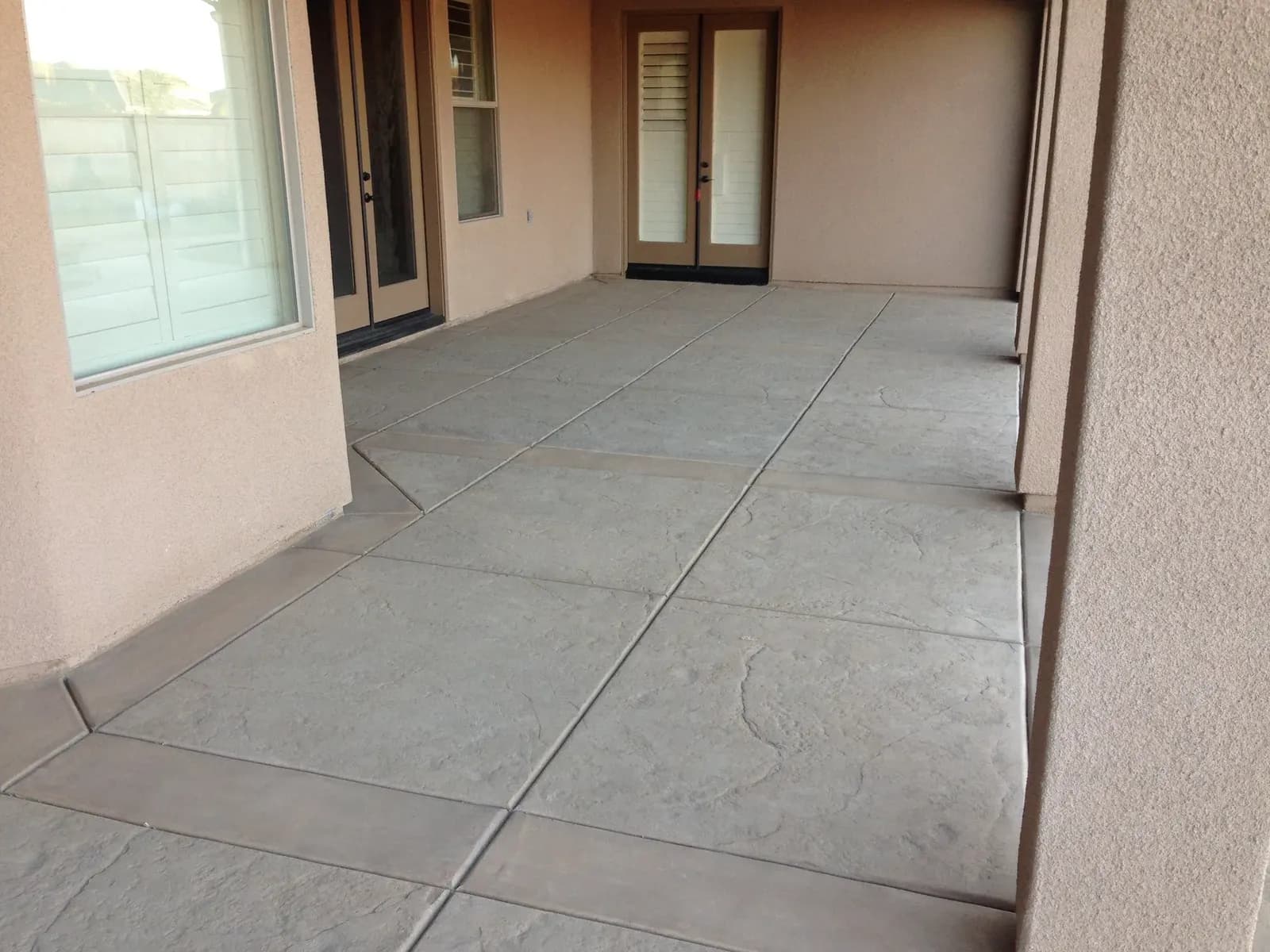
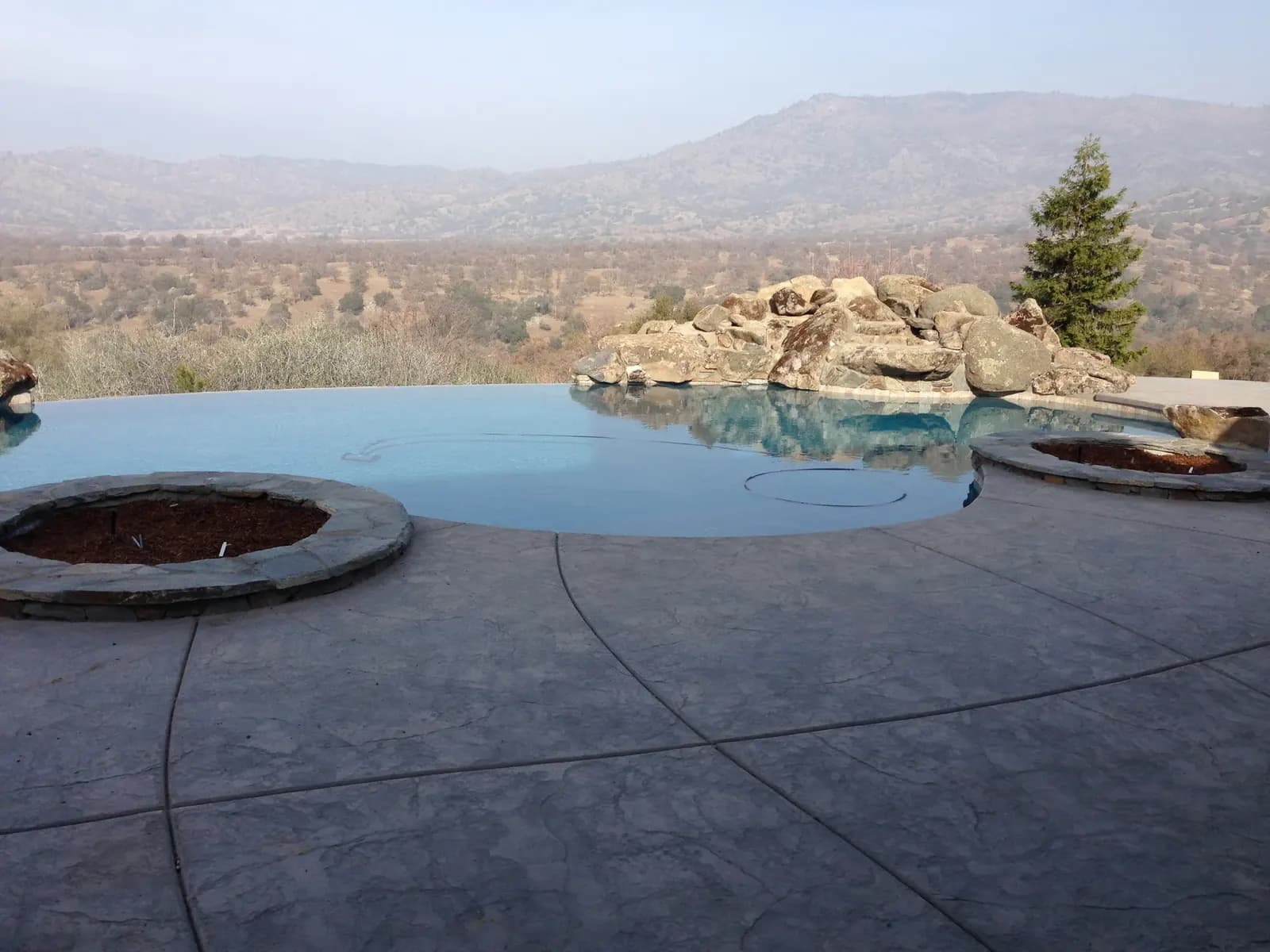
The best pool deck material for a Fresno summer
For a Fresno or Clovis pool deck that has to survive July, the best surface is light colored exposed aggregate concrete, with a light broom finish a very close second and a light textured cool coating the best answer on an existing deck. Those three give you the combination that actually matters here: a surface that stays tolerable barefoot at three in the afternoon, grips when it is wet, and lasts decades.
Everything else is a trade against one of those. Dark stamped concrete looks superb and is punishing underfoot in full sun. Pavers are good and cost more. Natural stone is beautiful and expensive. The question to answer before you pick anything is simple: how far do people have to walk barefoot between the slider and the water, and is any of that walk shaded? In most valley yards the answer is ten to thirty feet of full sun, and that answer should drive the decision.
- Coolest and toughest on a new deck: light exposed aggregate
- Best value with excellent grip: light broom finish concrete
- Best fix for an existing hot deck: light textured cool coating
- Looks the best, runs the hottest: dark stamped and colored concrete
- Good but pricier: light concrete pavers or travertine
For a Fresno or Clovis pool deck that has to survive July, the best surface is light colored exposed aggregate concrete, with a light broom finish a very close second and a light textured cool coating the best answer on an existing deck. Those three give you the combination that actually matters here: a surface that stays tolerable barefoot at three in the afternoon, grips when it is wet, and lasts decades.
How hot each surface really gets in July
On a 105 degree Fresno afternoon, ambient air temperature is the least of it. Surfaces in full sun run far above air temperature, and the spread between a dark deck and a light one is bigger than most people expect. A charcoal or dark gray surface in direct sun can climb past 150 degrees on the hottest afternoons, which is the temperature at which children stop walking and start running. A light tan, sand or bone colored surface in the same sun commonly runs twenty to thirty degrees cooler.
Texture does the rest. A smooth, sealed surface puts your whole foot in contact with hot material. A textured surface, whether that is the washed stone of exposed aggregate, the ridges of a broom finish, or the profile of a cool coating, reduces the contact area and feels cooler than a thermometer alone would suggest. That is why a light textured deck beats a light smooth deck by a noticeable margin even when the readings are similar.
Exposed aggregate, the valley classic
Exposed aggregate is the finish this valley has put around pools for fifty years, and it earned that. The surface is washed back to reveal the natural stone in the concrete mix, which gives excellent slip resistance wet or dry, a texture that stays cooler underfoot than a smooth surface, and a look that has not really dated. It is also extremely durable, because the wear surface is the stone rather than a thin layer of paste.
It is the finish we are asked to match more than any other, usually on forty year old decks in older Fresno and Clovis neighborhoods where a section has failed and the rest is fine. Two things to know. The stone selection drives both the look and the temperature, so a lighter blend is worth asking for. And an old exposed aggregate deck that has lost its stone and gone smooth is a perfect candidate for resurfacing rather than replacement, which is a much smaller number.
Broom finish, the workhorse
Broom finish concrete is the most underrated pool deck surface in this market. It is the least expensive finish we pour, at roughly $9 to $14 per square foot in 2026, the broom texture grips reliably when wet, and in a light natural gray or a light integral color it stays genuinely comfortable underfoot. It also asks nothing of you: no sealing schedule, no joint sand, no recoating. For a family with children running in and out of the water all summer, that matters more than it sounds.
The objection is that it looks plain, and that is fixable for very little money. A saw cut pattern, a color band at the coping, an exposed aggregate or paver border, or a second integral color in an accent field turns a plain broom deck into something designed. That combination, light broom finish in the barefoot zone with a decorative border, is what we build most often on valley pool decks and it is the best value on this list by a wide margin.
- Around $9 to $14 per square foot in 2026
- Reliable grip wet, which matters most within a few feet of the water
- No sealer required, so nothing to maintain on a schedule
- Add a saw cut pattern or a decorative border for the look, at little extra cost
Want your yard priced?
Free estimate, we walk it with you.
Stamped and decorative concrete on a pool deck
Stamped concrete around a pool is beautiful and we build a lot of it, so this is not an argument against it. It is an argument for where to put it. A dark stamped deck in full sun is the hottest surface on this list, and a sealed stamped surface is slicker when wet than a broom finish, which is the last thing you want between the steps and the coping.
So we use it deliberately. Stamped work goes in the shaded lounge area, under a cover, on the far side of the deck away from the water line, or as a border and banding rather than the whole field. If you want stamped across the entire deck, specify a light color, ask for a slip additive in the sealer, and plan shade over the walking route. Done that way it works. Done in charcoal, in full sun, with a glossy sealer, it is the deck people call us to resurface five years later.
Pavers, travertine and cool coatings
Light concrete pavers are a good pool deck and cost more, at roughly $16 to $26 per square foot. They stay reasonably cool in pale tones, they can be lifted and reset if the pool is ever remodeled, and they handle movement at the coping well. The trade is joints, which in a Fresno yard means weeds, ants and joint sand to refresh every several years. Travertine is the coolest natural stone commonly used here and it is the premium end of the range.
For a deck that is already there and simply too hot, a light textured cool coating is the fastest and cheapest fix at roughly $6 to $10 per square foot. Kool Deck style coatings have been the valley answer for decades, they refresh a dated surface completely, and they buy back the middle of the afternoon. They need recoating eventually, which is the honest trade against a new pour. On a deck that is structurally sound, it is the best value in this whole article.
- Light pavers: cool, repairable, about $16 to $26 per square foot, joints to maintain
- Travertine: coolest stone commonly used here, premium pricing
- Cool coating over sound concrete: about $6 to $10 per square foot, recoat eventually
- Dark anything, in full sun, is the wrong answer regardless of material
Grip, coping and where the water goes
Heat gets the attention, but the drainage and the grip are what make a deck safe and what makes it last. Slope gets set before the pour, falling away from the house and away from the pool, so water leaves rather than sitting in the low spot by the back door. Control joints are cut where the slab wants to move. Deck drains and channel drains go where the grade cannot do the job on its own, and the expansion joint at the coping is what lets everything move in July without tearing the tile behind it.
Then we check it. Before we call a pool deck finished, the surface gets looked over for standing water and anywhere it collects gets corrected. The coping detail matters too. A cantilever edge poured with the deck gives the cleanest line, and precast or stone coping suits a more traditional pool. Whichever you pick, the joint at that edge gets sealed and it gets maintained.
What we would build for your yard
Walk out at four in the afternoon in July and see where the sun actually lands. Whatever is in that zone should be light and textured, and that is usually light exposed aggregate or a light broom finish with a saw cut pattern. Whatever is shaded can be as decorative as you like, which is where the stamped work, the darker accent bands and the paver inlays go. That split gets you a deck that photographs well and that children can cross without hopping.
We build and resurface decks throughout Fresno, Clovis, Madera, Sanger, Selma, Reedley and out to Visalia, Hanford and Lemoore, with the finish chosen for the afternoon sun it is going to take. It is the work our customers write about most, the family has been pouring valley concrete since April 1980, and the rating is 5.0 across 29 Google reviews. Send the form for a free written estimate.
Questions we get about this
The follow ups this subject raises once somebody starts pricing it for real.
What is the coolest pool deck surface for Fresno?
A light colored, textured surface, whichever material carries it. Light exposed aggregate concrete, a light broom finish, and a light textured cool coating all run roughly twenty to thirty degrees cooler than a dark gray or charcoal deck in the same July sun. Color does most of the work and texture does the rest, because texture reduces how much of your foot touches hot material.
Is exposed aggregate slippery around a pool?
No, it is one of the better surfaces for grip wet or dry, because the exposed stone gives the foot something to hold. That is why it became the standard valley pool deck finish decades ago and why we are still asked to match it on forty year old decks. The surfaces to be careful with are smooth sealed finishes, which is why any sealer near water gets a slip additive.
Can I put stamped concrete around my pool?
Yes, and we build it often. Specify a light color, put a slip additive in the sealer, and keep the stamped work in the shaded lounge areas or use it as a border rather than covering the whole barefoot zone. A dark charcoal stamp in full Fresno sun is the deck homeowners ask us to resurface a few years later, purely because of how it feels underfoot.
Salas Outdoor
Written by the crew that does the work. Family owned since 1980, backyard remodeling and concrete across Fresno, Clovis and the Central Valley.