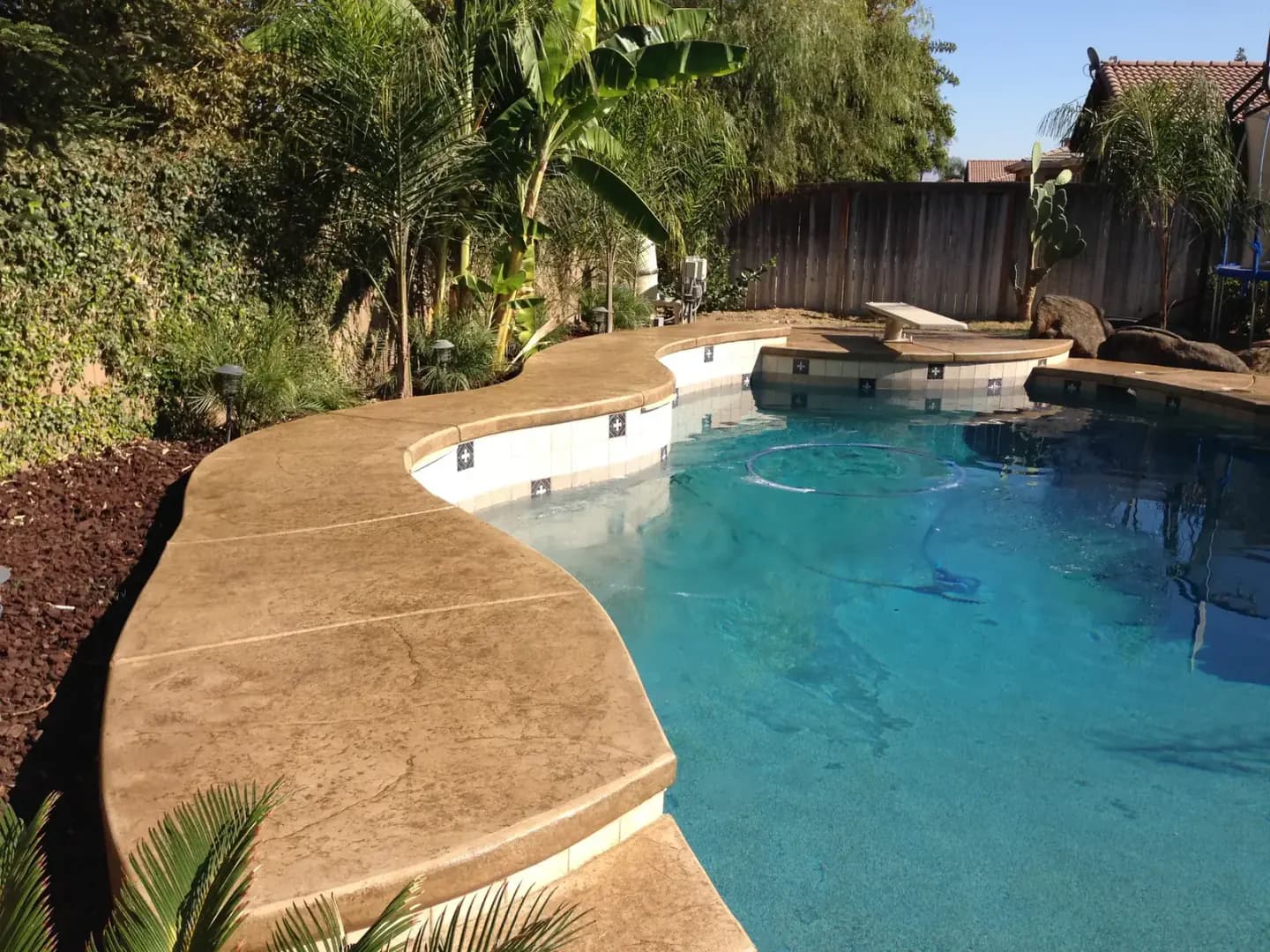
Four things a valley pool deck has to do
A pool deck earns its keep by doing four things at once: staying tolerable under bare feet in a 105 degree July, staying grippy when it is wet, moving water away from the pool instead of into it, and looking like it belongs to the house rather than to the pool. Get those right and the finish choice becomes a pleasure rather than a gamble. Everything else in this article sits downstream of those four requirements, so they are worth settling first.
Pool decks are the most reviewed work we do. Deck remodels, resurfacing, coping, drainage and repairs around fixed equipment like skimmers are the heart of the business, and the family has been pouring flatwork across Fresno, Clovis and Madera since 1980. We do deck work throughout the valley, including Fresno and Clovis, and we design it alongside the patio, the shade and the kitchen so the whole backyard works as one space.
A pool deck earns its keep by doing four things at once: staying tolerable under bare feet in a 105 degree July, staying grippy when it is wet, moving water away from the pool instead of into it, and looking like it belongs to the house rather than to the pool. Get those right and the finish choice becomes a pleasure rather than a gamble. Everything else in this article sits downstream of those four requirements, so they are worth settling first.
Heat underfoot drives the finish
In this climate, surface temperature is the first filter, not the last. Two things control it: color and texture. Lighter tones absorb less heat, and textured surfaces put less material in contact with your foot at once, so a light exposed aggregate or a light broom finish is dramatically more comfortable at four in the afternoon than a dark smooth slab. This is the single most common thing homeowners tell us they wish they had known before their last deck.
Cool coatings and Kool Deck style finishes exist specifically for this, and they work. Applied over sound concrete, a textured cementitious cool coating drops surface temperature noticeably and gives good wet grip. On a deck that is structurally fine but tired, that is often the entire remodel. They do need sound concrete underneath, so we look hard at the existing deck first rather than selling a coating over a slab that has already moved.
The other lever is shade. A freestanding cover over the lounge end of a deck, or a pergola on the west side, changes the usable hours of the whole backyard more than any finish decision can. Shade protects the deck itself as well, since a surface that is not baking all afternoon holds its color and its sealer longer. On a west facing Clovis or Visalia backyard, a cover at the lounge end changes the feel of the whole space.
- Light tones over dark, every time, on an uncovered deck
- Texture beats smooth for both heat and grip
- Cool coatings over sound concrete where the deck is otherwise fine
- Shade structures on the west and southwest side
- Keep dark accent colors for borders and bands, not the main field
Exposed aggregate, broom and stamped around water
Exposed aggregate is the classic Central Valley pool deck for a reason. It is naturally slip resistant, it stays comfortable underfoot, it hides splash marks and leaf litter, and it lasts. We have replaced decks in this finish that were poured 47 years ago and only reached the end of their life recently. A seeded aggregate lets you pick the stone color, which is how you tie the deck to the house rather than accepting whatever the local mix looks like.
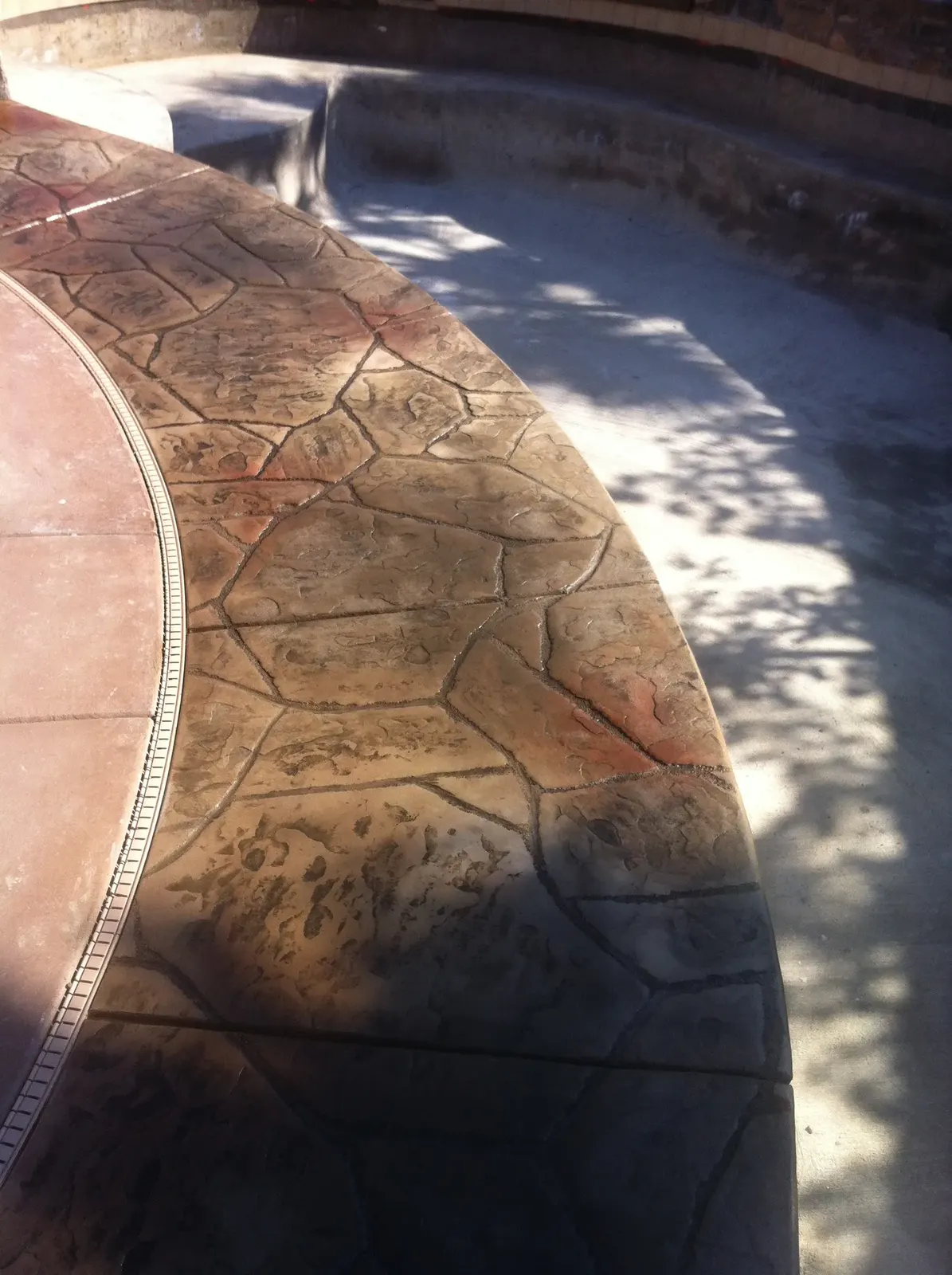
Broom finish is the value option and a genuinely good one around water, because it grips wet and takes color well. Stamped concrete is popular and needs more care here: a textured stamp pattern in a light tone with a slip resistant sealer additive works beautifully, while a dark, smooth, heavily sealed stamp around a pool is asking for hot feet and a slick surface. Around water, grip and heat come before pattern, and the pattern is still available once those two are solved.
What goes around your pool gets mixed and finished for grip, heat and drainage, in that order. The mix, the finish and the slope are all chosen for a pool deck rather than borrowed from a driveway.
Coping, borders and the waterline edge
The edge where the deck meets the water is what your eye goes to, so it deserves the detail budget. Cantilever coping pours the deck concrete over the top of the pool wall with a formed, bullnosed edge, giving a continuous surface with no separate coping stones, which is clean, modern and very common on our remodels. Precast and natural stone coping sit as a separate band on top of the wall and give you a defined edge in a contrasting material, which is the traditional look.
Around the rest of the deck, a border does the same work it does on a patio. A contrasting band of stamped concrete, brick or pavers around an exposed aggregate or broomed field makes a large deck read as designed and gives the eye a line to follow. Bands also break up the expanse on a big deck, which matters visually when a pool deck can easily run over a thousand square feet.
Detailing around the fixed items is what separates good deck work from average. Skimmers, returns, autofill lids, light niches, ladder and rail anchors and the equipment pad all have to be accommodated cleanly. Those details are also where a deck shows its age, so we form and finish them cleanly instead of patching around them. On a remodel we work with whatever equipment is staying, including skimmers we have no intention of disturbing.
- Cantilever coping for a continuous, contemporary edge
- Precast or natural stone coping for a defined traditional band
- A contrasting border band to organize a large deck
- Clean detailing at skimmers, returns, niches and rail anchors
- Bullnose edges anywhere feet and hands meet the concrete
Want your yard priced?
Free estimate, we walk it with you.
Size and layout around the water
Deck width should follow how each side of the pool gets used, not a single number applied all the way around. The lounge side wants enough depth for a chaise plus a walking path behind it, which is realistically ten to twelve feet. A simple circulation side can be four to five feet. The deep end and the diving or slide side needs clear space for obvious reasons. The shallow end is where people actually gather, so that is where a wider deck pays off.
Then think about what else sits on the deck. A dining table near the house, a shaded lounge zone at the far end, a spa, a barbecue island or an outdoor kitchen. Each of those needs its own footprint with clearance, and the paths between them should not run between a sunbather and the water. Leave a clear route from the back door to the water that does not cut through the lounge area, because that is the path everybody takes with wet feet.
Where the deck meets turf or planting, set the levels so the transition is flush and the drainage still works. Where it meets the patio, carry a material or a border across so the two read as one backyard instead of two projects. Levels matter at every edge of a deck. A lip where concrete meets turf collects water and catches toes, and it is easy to avoid when both are installed by the same crew working to one grade plan.
- Ten to twelve feet on the lounge side for chaises plus a path
- Four to five feet where the deck is only circulation
- Extra width at the shallow end, where people gather
- Dedicated zones for dining, a spa and a kitchen, each with clearance
- Flush transitions to turf, planting and the patio
Drainage, slope and deck drains
This is the part that has to be right, and it is decided before anything is poured. The deck is sloped away from the water so rain, splash and hose water do not carry dirt back into the pool, and away from the house so nothing runs at the foundation. Deck drains and area drains go where the grade genuinely needs them, tied to a discharge point that works, which matters especially in valley yards where a hardpan layer stops water soaking away.
Expansion joints between the deck and the pool shell, and control joints through the field, let the concrete move without tearing. Joints are cut early and placed to work with the slope rather than damming it. When the deck is finished, we check it for standing water before we call the job complete and address anything we find. The joints go in early for exactly the same reason we cut them early on a patio.
Tree roots are the other valley specific issue. Mature landscaping around an older Fresno pool sends roots along the top of the hardpan and straight under the deck. On one deck replacement we dug out invasive roots, installed a root barrier and then poured, so the cause was removed instead of paved over. Root barriers are cheap compared with pouring the same deck twice, and in a mature Fresno or Sanger yard they are usually the difference between a deck that lasts and one that lifts again.
- Slope set away from the pool and away from the house before the pour
- Deck drains and area drains placed off the real grade
- Expansion joint at the pool shell, control joints through the field
- Root removal and root barriers where mature trees caused the failure
- Finished surface checked for standing water, and revisited if it sits
Resurfacing versus replacing
Not every tired deck needs demolition. If the concrete underneath is structurally sound, with no significant settlement and no full depth cracking, an overlay or a cool coating gives you a new surface, new color and better heat performance for considerably less than a replacement. That is often the right call on a deck that simply looks dated. It is also far less disruptive, since there is no demolition, no haul off and no equipment tracking through your side yard.
Replacement is the answer when the slab has moved, when it holds water because the slope was wrong from the start, when roots have lifted it, or when full depth cracks are growing. Resurfacing over a slab with those problems buys you two summers and then the same failure reappears through the new surface. We would rather tell you that at the estimate than take the easier job and see you again in two years.
Partial replacement is a real option too. We have removed damaged sections around a skimmer without disturbing the skimmer itself, then poured a new section with a matched finish. The owner will come out, look at what you actually have, and tell you which of the three your deck needs. Estimates are free, and we aim to make that visit happen the same day or within 24 hours if it is not a weekend. Nothing about that conversation obligates you, and you will get a straight answer about which of the options your deck actually needs.
Tying the deck to the patio and the kitchen
The backyards that feel finished are the ones where the deck is not a separate island. That means carrying a border material, a joint pattern or a color across from the patio to the deck, lining up the saw cut lines so they run through rather than stopping at an arbitrary seam, and putting the shade structures, the fire feature and the kitchen where they serve both areas. Those are small alignment decisions that cost nothing and change how the whole yard reads.
Practically, it also means trenching gas, water, power and drainage lines once, before any concrete goes down, for everything on the plan. That is where a single company doing the flatwork, the structures, the kitchen and the landscaping saves real money and real disruption, instead of three trades cutting into each other's finished work. It is also why a Salas backyard tends to finish faster: one crew, one schedule and one person answering the phone when you have a question.
One valley homeowner had us renovate the pool deck and patio together and wrote that the deck and the finish came out better than expected. That is what building it as one project rather than three is for. Salas Outdoor handles pool deck work, resurfacing, patios and full backyard remodels across Fresno, Clovis, Madera, Sanger, Selma, Hanford and Lemoore.
Questions we get about this
The follow ups this subject raises once somebody starts pricing it for real.
What is the coolest pool deck surface for a Fresno summer?
A light colored, textured surface. Light exposed aggregate and light broom finishes are the two most comfortable poured options, and a textured cool coating over sound concrete is designed specifically to reduce surface temperature. Dark, smooth and heavily sealed surfaces are the ones that get punishing at four in the afternoon. Shade over the lounge area helps more than any finish on its own.
Can my pool deck be resurfaced instead of replaced?
Often, yes. If the slab is structurally sound with no significant settlement or full depth cracking, an overlay or cool coating gives you a new surface and better heat performance for much less than a rebuild. If the deck has moved, holds water from bad original slope, or has been lifted by tree roots, replacement is the honest answer, because those problems come straight back through an overlay.
How do you stop water draining into the pool?
Slope and drains, both planned before the pour. The deck is graded away from the water and away from the house, deck drains and area drains are placed where the grade needs them, and the system is given a real discharge point rather than a pipe that ends in a planter. We check the finished deck for standing water before calling it done, and we come back if water sits.
Salas Outdoor
Written by the crew that does the work. Family owned since 1980, backyard remodeling and concrete across Fresno, Clovis and the Central Valley.