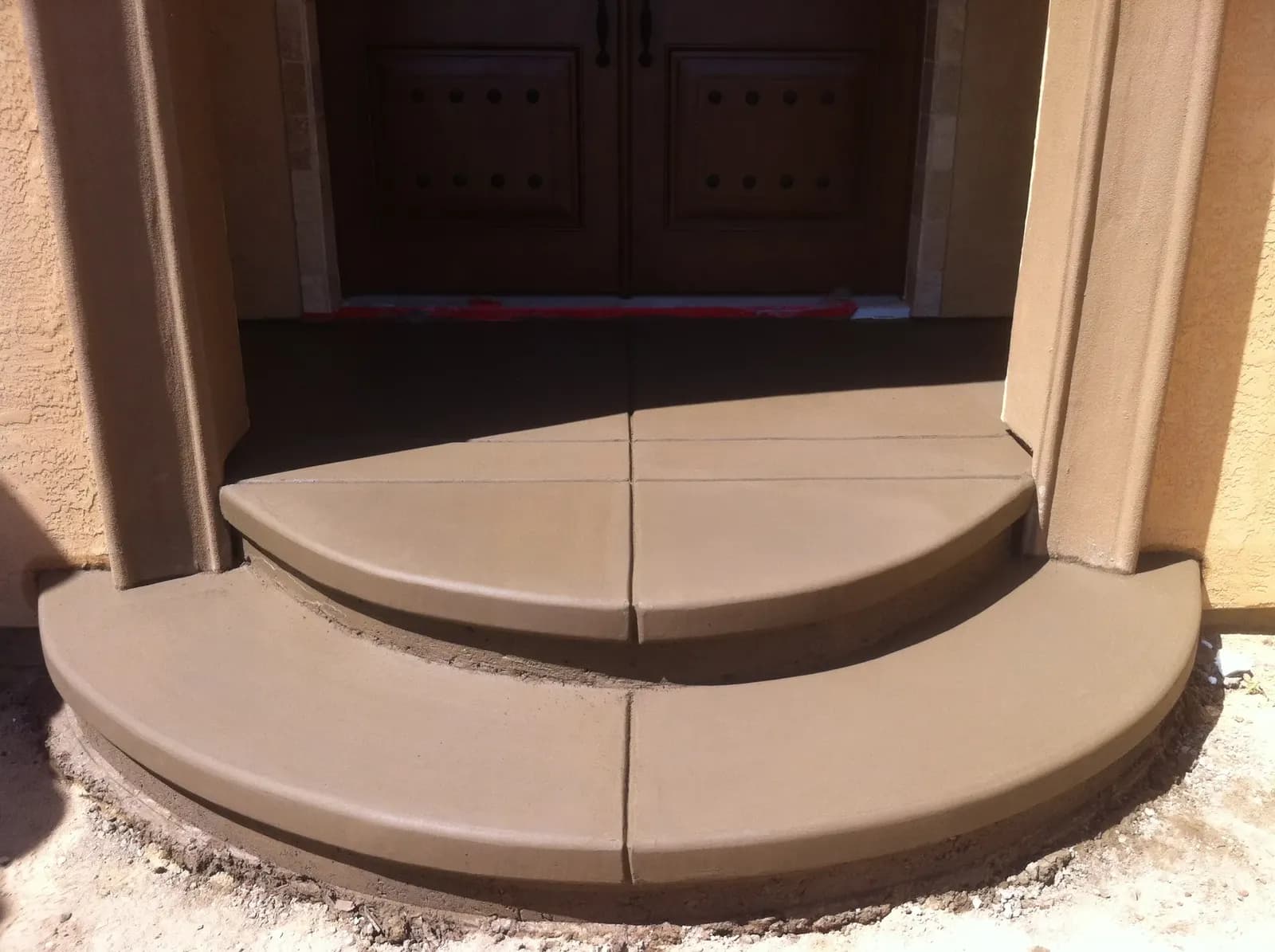
What hardpan is, and what it does to a slab
Hardpan is a cemented layer of soil sitting under most of the Central Valley, often a foot or two below the grass, and it is the single biggest thing that decides how a slab gets built here. It will not soften, it does not drain, and concrete placed on top of it without the right prep is the concrete that fails first. Dig into a backyard in Clovis or out toward Sanger and you hit a layer that rings against the shovel. That is old alluvial soil where lime, silica and clay have fused the particles into a hard pan, which is where the name came from.
It is not the same on every lot. Some Clovis yards have eight inches of workable topsoil over two feet of pan. Some Madera parcels have it sitting right at grade under an inch of dust. Out past Friant you find a shallow pan with fractured rock underneath that drains reasonably well. That variation is exactly why we dig test holes and walk the yard before we price anything, instead of assuming your soil behaves like the yard we poured last week.
- Depth varies lot to lot, sometimes within the same block
- Thickness runs from a few inches to several feet
- It is hard when dry and slick when wet, which is the worst of both
- Older neighborhoods often have fill or trench spoil layered over it
Hardpan is a cemented layer of soil sitting under most of the Central Valley, often a foot or two below the grass, and it is the single biggest thing that decides how a slab gets built here. It will not soften, it does not drain, and concrete placed on top of it without the right prep is the concrete that fails first. Dig into a backyard in Clovis or out toward Sanger and you hit a layer that rings against the shovel. That is old alluvial soil where lime, silica and clay have fused the particles into a hard pan, which is where the name came from.
Why hardpan looks like a finished base and is not
Stand on exposed hardpan and it feels like a parking lot. It is unyielding, it takes a footprint from a loaded wheelbarrow without denting, and every instinct says a slab could go straight on it. That instinct costs homeowners real money. A proper base works because crushed aggregate has interlocking angular particles and graded voids, so it spreads load sideways and lets water move through. Hardpan does neither. It behaves like a brittle plate: strong until it is not, and when it fractures under a point load it does so in sheets rather than settling gently.
The strength of the finished slab is only half the equation. The other half is what it sits on. A perfectly mixed pour on an unprepared pad will still crack where the ground breaks underneath it. We would rather explain that once, up front, than have you wonder later why the prep line on your estimate is more than a formality.
There is a second trap. The soil sitting on top of the pan is often expansive clay. It swells when it takes on water and shrinks when it dries out, and in a valley summer it dries out hard. So you get a stable layer below and a moving layer above, and the slab has to be designed for both. Base depth, reinforcement and joint spacing are how we handle that combination, and the numbers change depending on which of those two layers is dominant under your yard.
Water does not go through it, so it has to go somewhere
The practical problem with hardpan is drainage. Rain and irrigation move down through the topsoil, reach the pan, and stop. They then travel sideways along the top of that layer, which means water collects under the edge of a patio, under a driveway apron, or against a house footing, and sits there. You see the results all over Fresno after a wet February: soft spots at the slab edge, efflorescence blooming on the surface, planter beds that stay soggy for a week after the rain stops.
That is why the drainage plan on a Salas Outdoor project starts before anything is poured, not after the first puddle. We set the fall away from the house and the pool, cut control joints where the slab wants to move, and put deck drains and area drains where the grade actually needs them rather than where they are convenient to trench. Then we check the finished surface for standing water before we call the job done and correct whatever we find.
- Slope set before the pour, not chased afterwards
- Area drains and deck drains placed off the real grade, with a discharge point that works
- Subdrain or gravel trench where water is trapped on top of the pan
- Downspouts routed away from the slab edge instead of onto it
How a slab gets designed around hardpan
The build is straightforward once you know what is under there. We strip the loose and organic material, get to competent soil, then bring in and compact a base of crushed aggregate so the slab has something that spreads load and breathes. Depth depends on what the slab is for. A patio that carries patio furniture and a barbecue needs less than a driveway that will carry a loaded work truck, and an RV pad needs more again.
Reinforcement does the rest. Rebar on chairs or a proper mat of mesh held up in the slab, not laid on the dirt and hoped for, keeps the two sides of any future crack locked together and level. Control joints are cut early and at the right spacing so the concrete cracks where we tell it to.
- Strip organics and unstable fill, then compact in lifts
- Crushed aggregate base, depth sized to the load the slab will carry
- Rebar or mesh supported at the right height inside the pour, never on the ground
- Control joints cut early, spaced to the slab thickness and shape
- Thickened edges where a cover post, a wall or a vehicle wheel path lands
Want your yard priced?
Free estimate, we walk it with you.
When the pan has to be ripped and recompacted
Sometimes the right move is to break the pan up rather than build over it. If the layer is shallow, uneven, or holding water directly under the footprint of the new work, we rip it with a toothed bucket or a ripper shank, break it into a workable material, then moisture condition it and compact it back in lifts. What comes out is a uniform engineered base instead of a fractured plate with soft pockets under it.
That call gets made on the site, not in the office. Ripping adds cost, so we only recommend it where it changes the outcome: a driveway that has to take truck traffic, a slab that will sit under a patio cover with point loads at every post, a pool deck where the excavation already disturbed the layer, or a yard where water is visibly perched on top of the pan. On plenty of Fowler and Kerman jobs the pan is deep enough and consistent enough that a clean base over the top is genuinely the better build.
What happens to a driveway poured straight onto hardpan
This is the failure we get called out to look at most often, usually four to eight years after somebody else poured it. The slab goes down thin, directly on the pan, with no base and mesh lying flat on the soil. It looks perfect for two summers. Then a wheel path develops a straight crack, the crack opens, water gets in through it and under the edge, the pan below fractures under repeated load, and one side of the crack drops. Now you have a lip you can catch a toe on and a driveway that cannot be ground flat because the problem is underneath.
The parts of that sequence you can actually control are all decided before the truck arrives. Base thickness, compaction, slab thickness, steel, joint layout and drainage. A driveway in Selma or Kingsburg that gets those right will outlive the house. That is also why we would rather quote what your yard needs than match a number from a contractor who priced it without digging. We will show you what came out of the test holes and explain what each line of the prep is buying you, so the price makes sense before you agree to anything.
What we look at in your yard before we price it
A free estimate here means The owner comes out, walks the yard with you, and looks at the actual conditions. We aim to make that visit happen the same day, or within 24 hours if it is not a weekend. We dig where the work is going, look at how deep the pan sits, check what the topsoil does when it is wet, find out where the water goes now, and look at what the trees nearby are doing underground, because mature valley landscaping sends roots along the top of the pan and straight under flatwork.
Then you get a clear written price built around what we found, including the base and the drainage rather than leaving those as surprises. If the footage comes in under the allowance we quoted, you get credited back for what we did not pour. One Clovis homeowner wrote a review about exactly that after a one day patio build. That is the whole approach: charge for what we actually poured, and put the surprises in the estimate instead of in the final invoice.
- Test holes in the work area to find depth and thickness of the pan
- Where water currently stands after irrigation or rain
- Tree species and root paths near the proposed flatwork
- Existing slabs to tie into, and whether the finish can be matched
- Access for equipment, which decides whether ripping is even practical
Questions we get about this
The follow ups this subject raises once somebody starts pricing it for real.
Does hardpan mean my backyard costs more to build on?
Not automatically. Where the pan is deep and consistent, a properly compacted aggregate base over it is a normal build at a normal price. Cost goes up when the layer is shallow, uneven, or trapping water under the work, because then it has to be ripped and recompacted. We dig test holes during the estimate so the number you get already reflects your yard instead of a guess.
Can you just pour thicker concrete instead of prepping the base?
Thickness helps, but it does not fix what is underneath. A thick slab on an unprepared pan still cracks where the layer fractures below it, and you paid for extra concrete to get there. The money works harder in base depth, compaction, steel placement and joint layout. That combination is what keeps a slab flat and level for decades in Fresno and Madera soils.
Why does water stand in my yard days after it rains?
Almost always the hardpan layer. Water moves down through the topsoil, hits the cemented pan, and then travels sideways instead of soaking away, so it collects in the low spots and against slab edges. The fix is grading and a drain path with a real discharge point, planned alongside the flatwork rather than added after the concrete is already down.
Salas Outdoor
Written by the crew that does the work. Family owned since 1980, backyard remodeling and concrete across Fresno, Clovis and the Central Valley.