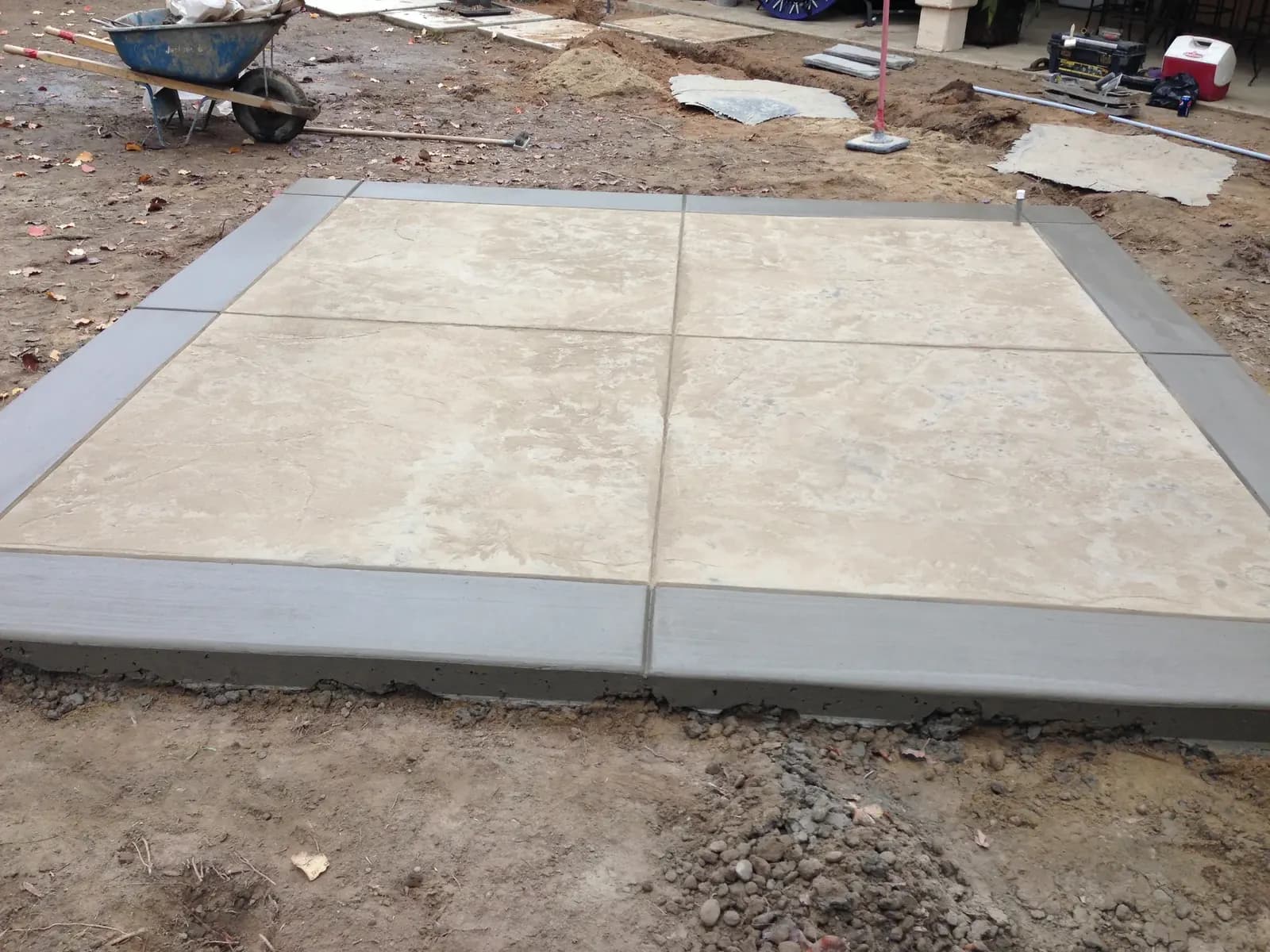
Set, walkable, drivable and fully cured
On a normal residential slab you can walk on new concrete after about 24 to 48 hours, drive a car on it after about 7 days, and it reaches its design strength at around 28 days. Those are four different milestones and people mix them up constantly, which is how a beautiful new driveway ends up with a tire scuff in it on day three. Knowing which of those milestones you are waiting for is most of what a homeowner needs, and we give you the dates for your specific job in writing.
Setting is the concrete going from liquid to solid, which happens in the first few hours. Walkable means the surface will carry your weight without marking. Drivable means the slab has enough strength to take the point load of a wheel without cracking. Fully cured means the chemical reaction has run far enough that it has the strength it was designed for. Curing never truly stops, concrete keeps gaining strength for years, but 28 days is the number the industry designs to.
- First few hours: initial set, finishing complete, curing begins
- 24 to 48 hours: foot traffic, forms usually stripped
- 7 days: roughly 70 percent of design strength, cars on a residential slab
- 28 days: design strength, heavy vehicles, sealing if you want it
On a normal residential slab you can walk on new concrete after about 24 to 48 hours, drive a car on it after about 7 days, and it reaches its design strength at around 28 days. Those are four different milestones and people mix them up constantly, which is how a beautiful new driveway ends up with a tire scuff in it on day three. Knowing which of those milestones you are waiting for is most of what a homeowner needs, and we give you the dates for your specific job in writing.
The first 24 to 48 hours
This is the window that decides how the surface will look for the next thirty years. The concrete is hard to the touch but still soft enough that a dog can leave prints, a dropped tool can chip an edge and a garden hose dragged across a corner can leave a mark. We ask you to keep pets, kids, bikes and furniture off the slab entirely for the first full day, and longer in cool weather when everything happens more slowly.
Edges and corners are the vulnerable parts. Curbs, steps and the outside edge of a patio have concrete exposed on two faces, so they gain strength more slowly than the middle of the slab and they are the first thing a wheelbarrow tire catches. If the crew has left barricades or caution tape around a driveway apron in Clovis, that is why. Give those edges a wide berth for the first couple of days and they will hold their line for decades.
We also start curing in this window, not later. On a valley summer day that means the surface is kept damp or sealed with curing compound from the moment it will take it. In cooler weather a curing compound or a cover does the same job over a longer window. Either way it is part of the pour rather than optional aftercare, and we will tell you exactly what your slab needs before the crew leaves the site.
About seven days before you drive on it
By day seven a normal residential mix has reached roughly seventy percent of its design strength, which is enough for passenger cars and light pickups on a properly built driveway. We give you a specific date with your job rather than a rule of thumb, because slab thickness, mix design, reinforcement and the weather that week all move the number. Ask us for that date rather than counting days from an article, including this one, because the slab that matters is the one in your driveway.
Two things stretch that timeline. Cool weather slows the reaction, so a February pour in Madera genuinely needs longer than a June pour. Heavy vehicles need much longer: a loaded RV, a moving truck, a concrete or dump truck, or a dumpster dropped on steel feet can punch a slab that would have handled a sedan without complaint. For those, wait the full 28 days and talk to us first about where to place the load.
Turning a wheel while stationary is also harder on a young slab than driving across it, so for the first few weeks, roll as you steer. Power steering makes it easy to grind a stationary tire against a young surface, and on a fresh driveway that scuffs the top layer. It is a small habit, it costs nothing, and it keeps a new apron in Clovis or Madera looking new through its first summer.
- Passenger cars and light trucks at about 7 days on a residential driveway
- Add time for cool weather, thin slabs or an unusually large pour
- RVs, moving trucks and dumpsters: wait 28 days and ask us where to park
- Avoid turning the wheel in place for the first few weeks
Twenty eight days to design strength
The 28 day mark exists because that is where test cylinders are broken to confirm a mix hit its specified strength. It is a convention, not a magic date, and the slab is not fragile at day 27 and invincible at day 29. Concrete gains most of its strength in the first week, a meaningful amount over the next three, and small amounts for years afterwards as the remaining cement continues to hydrate.
Practically, 28 days is when you stop thinking about the slab as new. Heavy loads are fine. If you are going to seal decorative work, stamped concrete or colored concrete, this is generally the earliest sensible point, since sealing too early traps moisture and can cloud the finish. For a plain broom finish patio in Fowler or Sanger, sealing is optional and plenty of homeowners never do it. If you are not sure whether your finish wants sealing at all, ask us before you go and buy a product for it.
Want your yard priced?
Free estimate, we walk it with you.
Why we wet a slab down in valley heat
Concrete does not dry, it cures. The cement reacts with water in a process called hydration, and that reaction needs water to continue. If a slab loses its moisture to a 105 degree afternoon before the reaction has run, hydration stalls, and the concrete simply never reaches the strength it was mixed for. You end up with a soft, dusty surface that wears and scuffs. That outcome is permanent, which is why we treat curing as part of the pour rather than as something that happens afterwards.
So in summer we keep new slabs wet. That can mean misting several times a day, running soaker hoses, covering with wet burlap, or applying a curing compound that seals the moisture in. It looks odd to hose down concrete you just paid for, and it is one of the highest value things anyone can do for a slab in this climate. If we ask you to water your new patio for a few days, that request is doing real work, and we will show you exactly how much and how often.
Cool cloudy weather does most of this for you, which is one more reason a fall pour is an easy pour in Fresno and Clovis. A slab poured in October or November in Fresno or Kingsburg holds its moisture far longer with no help from anyone, and it gains strength steadily while it does. That is one more reason we encourage homeowners who are not in a hurry to build in the fall.
- Mist or soaker hose several times a day in summer heat
- Wet burlap or curing blankets on large or high value pours
- Curing compound where watering is not practical
- Keep the surface damp, not flooded, and never let it dry and re-wet repeatedly
Hairline surface cracking versus a real crack
Not every line on a new slab is a problem. Fine surface hairlines, often in a random pattern and visible only when the concrete is damp, are usually plastic shrinkage or crazing in the top layer. They do not go through the slab, they do not affect strength, and they are largely a cosmetic feature of concrete as a material. Good curing is what keeps them to a minimum. They also tend to become less noticeable as the slab weathers through its first year.
A real crack is different. It runs through the thickness, it is often wider at one end, it usually travels between two joints or from a re-entrant corner, and over time one side may lift or drop relative to the other. That is a structural crack, and it comes from base movement, load, missing or badly placed steel, or joints cut too late or too far apart. Those are the things our prep is designed to control.
If something on your slab worries you, call us and send a photo with a coin next to it for scale. We would rather look at it early. Most of the time we can tell from the photo whether it is cosmetic or structural, and if it needs a visit, The owner comes out and looks at it. A crack that turns out to be nothing is worth the two minutes it takes to check.
- Hairline crazing: shallow, random, cosmetic, common in hot weather
- Control joint cracking: expected, the joint did its job
- Structural crack: full depth, opens over time, may show a vertical lip
- Any crack with movement or water travelling through it is worth a look
What you can do while it cures
Most of curing is patience, but there are a few things that genuinely help. Keep the surface damp for the first several days in warm weather. Keep vehicles, ladders, pot stands and metal furniture feet off it until we say otherwise. Keep sprinklers from blasting one small area repeatedly, since uneven wetting creates staining. Keep de-icing chemicals off it entirely, which matters on the handful of cold Friant and Kingsburg mornings each year.
Some surface discoloration in the first weeks is normal and evens out. Efflorescence, the white powdery bloom that can appear as moisture moves out through the surface, usually weathers off on its own and can be brushed or rinsed. And if you need to move something heavy across a young slab, lay plywood down first and spread the load. We are happy to talk through any of it before you try.
- Water it, do not seal it or wash it with chemicals
- Plywood under anything heavy for the first month
- Adjust sprinklers so they are not hitting the new concrete constantly
- Ask before you park a trailer, a dumpster or an RV on it
Questions we get about this
The follow ups this subject raises once somebody starts pricing it for real.
When can I put patio furniture on my new concrete?
Light furniture is usually fine after two or three days, and heavier pieces with narrow metal feet are better left until the end of the first week. Concentrated point loads are what mark a young slab, not overall weight, so a wide based table is gentler than a narrow chair leg. We will give you a date with your job based on the mix, the thickness and the weather that week.
Why is my new slab a patchy color?
Early color variation is normal and usually evens out over the first few months as the slab finishes curing and weathers. Uneven drying, sprinkler overspray hitting one area, curing compound applied at different rates and shade from a building or tree all contribute. If it is still noticeably patchy after the concrete has cured out, call us and we will come look at it.
Should I seal my new patio?
Decorative, stamped and colored concrete benefits from sealing, both for color depth and for protection, and we usually recommend waiting until the slab has cured before the first coat. A plain broom finish patio does not need it, and many valley homeowners never seal one. If you do seal, remember that a sealed surface can be slicker when wet, which matters around a pool.
Salas Outdoor
Written by the crew that does the work. Family owned since 1980, backyard remodeling and concrete across Fresno, Clovis and the Central Valley.