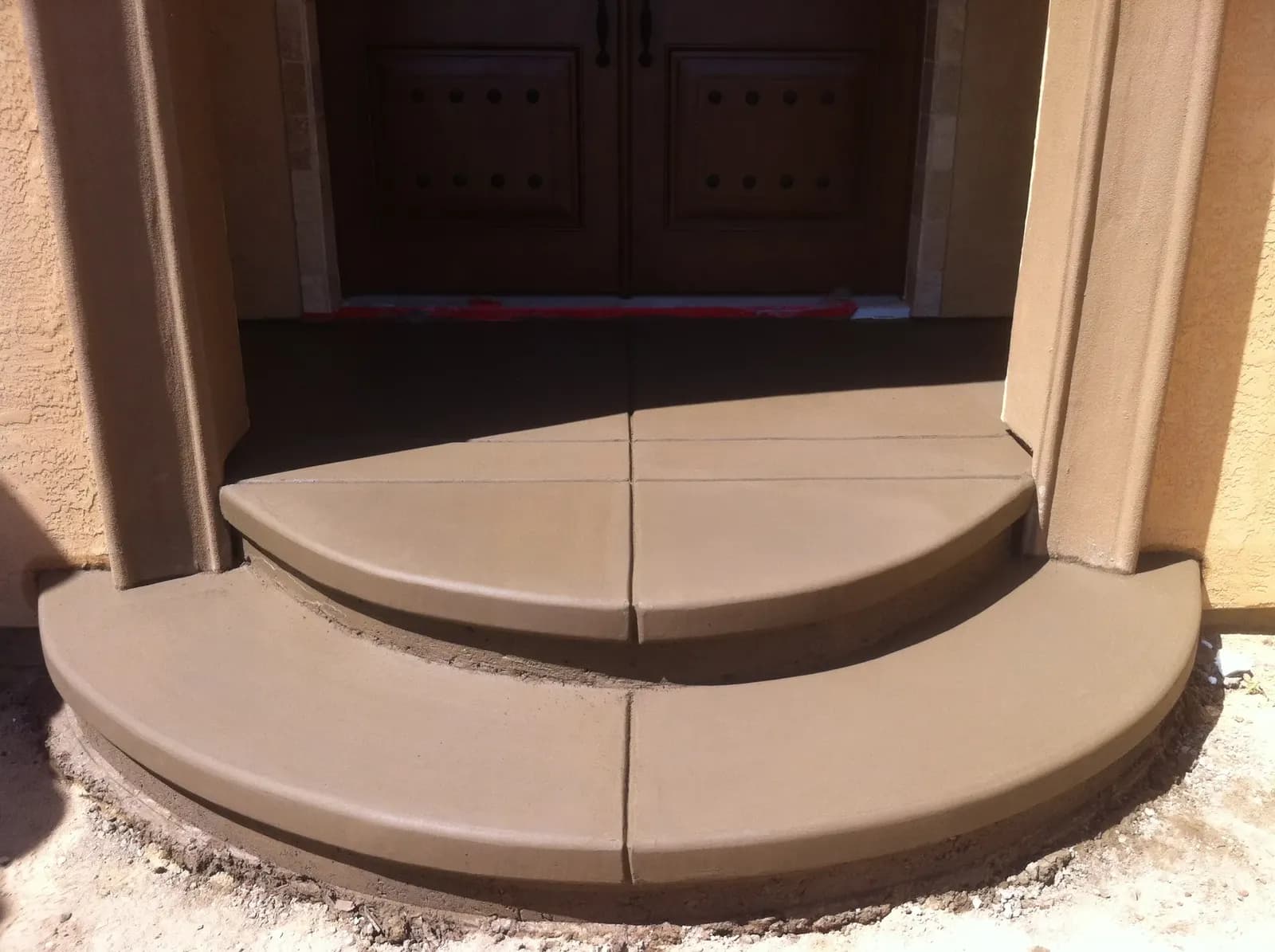
Pavers or concrete: the short answer
For most Central Valley backyards, poured concrete is the better buy, and for pool surrounds and anything sitting over utilities, pavers are worth the premium. That is the honest summary from a company that installs both and has no reason to push you either way. Concrete costs about 40 percent less installed, gives you an unbroken surface with nothing growing through it, and takes valley heat and hardpan well when it is prepped properly.
Pavers win where the surface has to come back up: over a gas line, a sewer cleanout or an irrigation main, and around a pool where the edge may be reworked one day. They win on repairability generally, because an individual paver can be lifted and replaced and the repair genuinely disappears. What they bring with them is joints, and joints in this valley mean weeds, ants and sand that migrates. Neither answer is wrong. They just fail differently, and it is worth knowing how before you pick.
For most Central Valley backyards, poured concrete is the better buy, and for pool surrounds and anything sitting over utilities, pavers are worth the premium. That is the honest summary from a company that installs both and has no reason to push you either way. Concrete costs about 40 percent less installed, gives you an unbroken surface with nothing growing through it, and takes valley heat and hardpan well when it is prepped properly.
What each one costs here
As of 2026, a broom finish concrete patio in Fresno and Clovis runs about $9 to $14 per square foot, and stamped and colored concrete runs about $16 to $24. Paver patios and surrounds run about $16 to $26 per square foot installed over a proper compacted base, and travertine or premium porcelain pavers run higher than that. Both numbers assume decent access. Both climb when the mixer or the pallet truck cannot get near the work.
Over a twenty year horizon the gap narrows but does not close. Pavers need joint sand topped up and the odd re level where something settled. Concrete in a decorative finish needs resealing every few years, and plain broom finish concrete needs essentially nothing. The real cost difference over time is what happens when something goes wrong, and that is the section below. Both are honest buys, and neither is the cheap option once the base work underneath is done properly.
- Broom finish concrete: about $9 to $14 per square foot
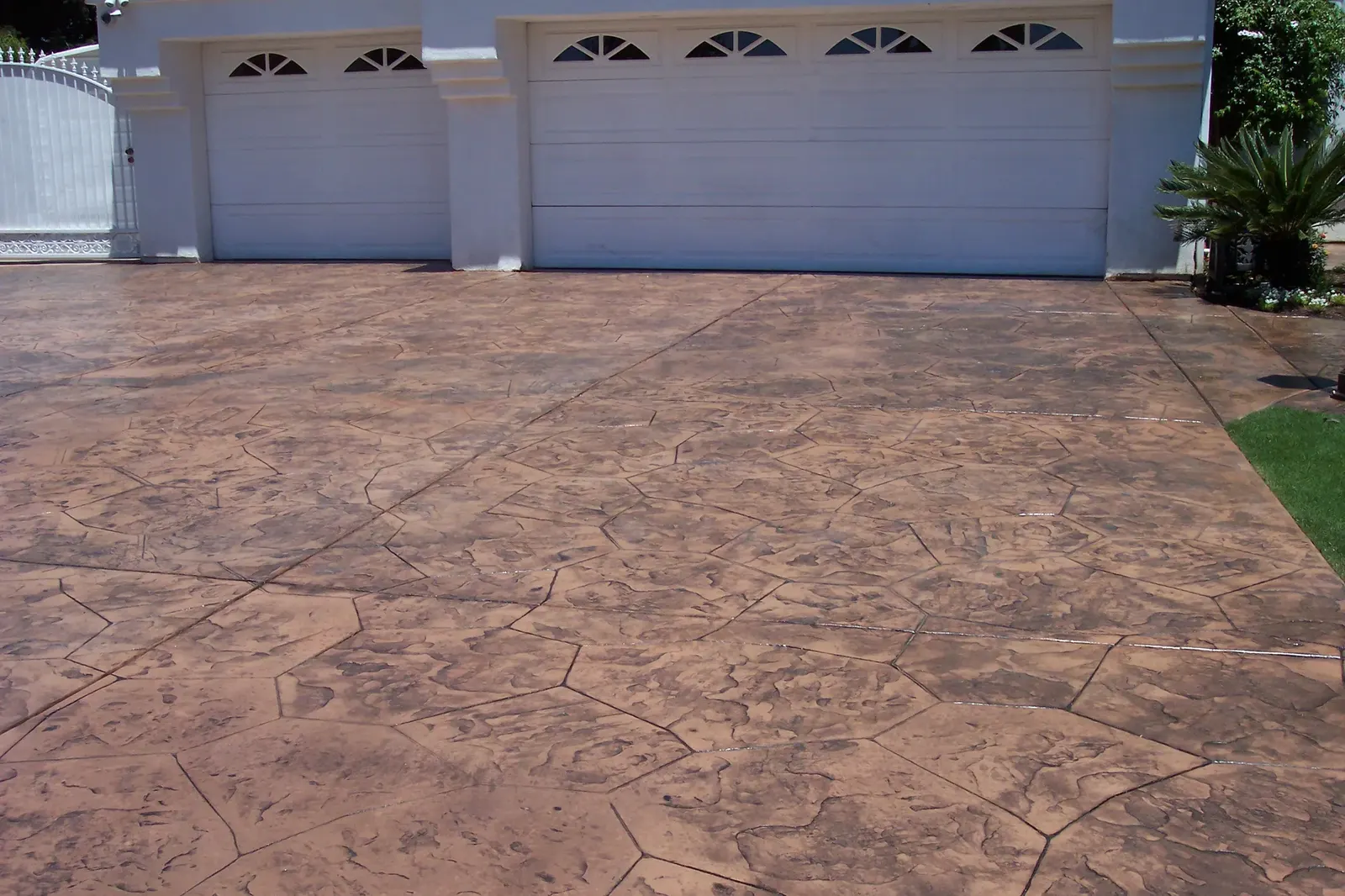
- Stamped and colored concrete: about $16 to $24 per square foot
- Standard concrete pavers: about $16 to $26 per square foot installed
- Travertine or premium porcelain pavers: usually above $26 per square foot
- Both add cost when the truck cannot reach the yard
Driveways: concrete wins, with one exception
For a driveway in Fresno, Clovis or Madera we recommend poured concrete almost every time. It is a monolithic reinforced slab, it takes a loaded truck without rutting, and there is nothing to migrate under repeated turning loads. Pavers on a driveway have to be laid on a much deeper compacted base to carry vehicles, which erases a good part of their cost advantage in flexibility, and the constant wheel loads at the turning points will eventually show as rippling if the base was even slightly under built.
The exception is a driveway that has to be opened later, or a circular or curved approach where the geometry would need a lot of saw cutting in concrete. If the utility company is going to be in your front yard, or a future addition means trenching under the drive, pavers over that run mean the repair costs an afternoon rather than a section replacement. That is a real scenario and it is worth spending the extra money on when it applies.
Pool surrounds: pavers, unless you want a cantilever edge
Around a pool, pavers are usually our recommendation. A pool deck has to live with movement at the coping, with chemistry splashing on it, and with the possibility that the pool gets remodeled in fifteen years, and a unit surface absorbs all three better. Pavers also stay somewhat cooler than a comparable dark concrete surface because the units are individually smaller and light colored options are easy to find. Around an older pool with a history of a little settlement at one corner, that flexibility is worth real money.
Concrete wins at the pool when you want a cantilever edge, where the deck is poured over the bond beam to form the coping in one continuous line. That detail is clean, it is what most modern pool deck remodeling projects are asking for, and pavers cannot do it. Concrete also wins on cost, and a light broom finish or exposed aggregate deck in a pale tone is one of the coolest barefoot surfaces available in this climate. So the call is really about the edge detail and the budget rather than about which material is better.
- Pavers: easier to lift and reset around future pool work, cooler in light tones
- Concrete: cantilever coping, lower cost, unbroken surface with no joint maintenance
- Either way, the expansion joint at the coping is what keeps the edge intact
- Light colors beat dark ones underfoot on both materials
Want your yard priced?
Free estimate, we walk it with you.
Patios: it depends on how you use the space
If the patio is a dining and lounging area with chairs that get dragged, a table, a barbecue and bare feet in the summer, we lean concrete. It is a flat continuous surface, chair legs do not catch on joint lines, nothing grows between anything, and the finish options from broom to saw cut to stamped cover almost any look people want. It also costs substantially less, which matters when you are also paying for a cover and a kitchen.
If the patio is decorative, curved, running through planting beds, or stepping down in levels, pavers often look better and build more easily. Curves and radii that require careful forming and saw cutting in concrete are just a cut line in pavers. And in a yard with mature valley landscaping, where roots are already at work under everything, a paver surface tolerates slow ground movement far more gracefully than a slab does.
Weeds, ants and joint sand, honestly
This is the part that paver brochures skip and that every valley homeowner with pavers already knows. Every joint is an opening, and in Fresno and Clovis that means two things: weeds and ants. Polymeric sand, swept in and activated correctly, makes both far less of a problem than plain sand does, and it is what we install. It is not permanent. Expect to top up and reactivate joints somewhere around the five to ten year mark, sooner in a heavily irrigated yard.
Ants in particular are relentless around here. They tunnel up through joints, push fine sand onto the surface, and over years that loss is what produces the slightly uneven feel older paver patios get. None of this is a reason to avoid pavers. It is a reason to budget an afternoon of maintenance every few years, and to weigh that against a concrete patio that asks nothing of you between reseals.
- Polymeric joint sand, properly installed, is the difference between annoying and awful
- Plan on refreshing joints roughly every five to ten years
- Keep irrigation spray off the paver field where you can
- Concrete has no joints for anything to live in, which is its quiet advantage
Settling, roots and twenty valley summers
Both materials sit on the same dirt, and in this valley that dirt is hardpan in one yard and expansive clay in the next. Concrete deals with movement by cracking, which is why we compact the subgrade, set reinforcement in the middle of the slab and cut control joints where the concrete wants to move, so it cracks along a line somebody chose rather than at random.
Pavers deal with movement by moving, which is both the advantage and the drawback. A tree root that would crack a slab will lift a paver field instead, and the field can be pulled up, the root dealt with and the pavers reset. It will also settle unevenly wherever the base was not compacted correctly, and that is the number one reason paver patios look tired at year fifteen. With pavers, more than with concrete, the base work is the whole job.
Resale, and how we would build it
Buyers in this market notice finished, clean and cohesive far more than they notice material. A well laid paver patio and a well finished concrete patio both read as a finished yard. A cracked slab or a rippled paver field both read as deferred maintenance. If you are building to sell in the next few years, spend the money on getting the whole yard coherent rather than on upgrading one surface.
In practice, the yards we like best use both. A poured concrete field with a paver band at the border, or a concrete pool deck with paver landings and a paver path through the planting, costs less than doing the whole yard in pavers and looks more designed than doing it all in concrete. We will tell you straight which material belongs where in your yard. Send the form for a free written estimate, usually the same day or within 24 hours if it is not a weekend.
Questions we get about this
The follow ups this subject raises once somebody starts pricing it for real.
Are pavers cooler than concrete in Fresno?
Slightly, and color matters far more than material. A light tan paver and a light broom finish concrete deck run within a few degrees of each other on a July afternoon. A dark charcoal paver and a dark stamped slab are both punishing barefoot. If heat is your priority, pick a light color and a textured finish first, then pick the material.
Which lasts longer, pavers or concrete?
Both last decades when the base is right. Concrete fails by cracking, which is controlled by compaction, reinforcement and joint placement. Pavers fail by settling and by joint sand loss, which is controlled by base depth and compaction. In both cases the prep decides the lifespan, which is why we do our own base work rather than subcontracting it.
Can you combine pavers and concrete in one yard?
Yes, and it is often the best looking and best value answer. A poured concrete field with a paver border, paver landings at the steps, or a paver path through planting beds costs less than an all paver yard and looks more intentional than an all concrete one. We install both with our own crews, so there is one schedule and one contract.
Salas Outdoor
Written by the crew that does the work. Family owned since 1980, backyard remodeling and concrete across Fresno, Clovis and the Central Valley.