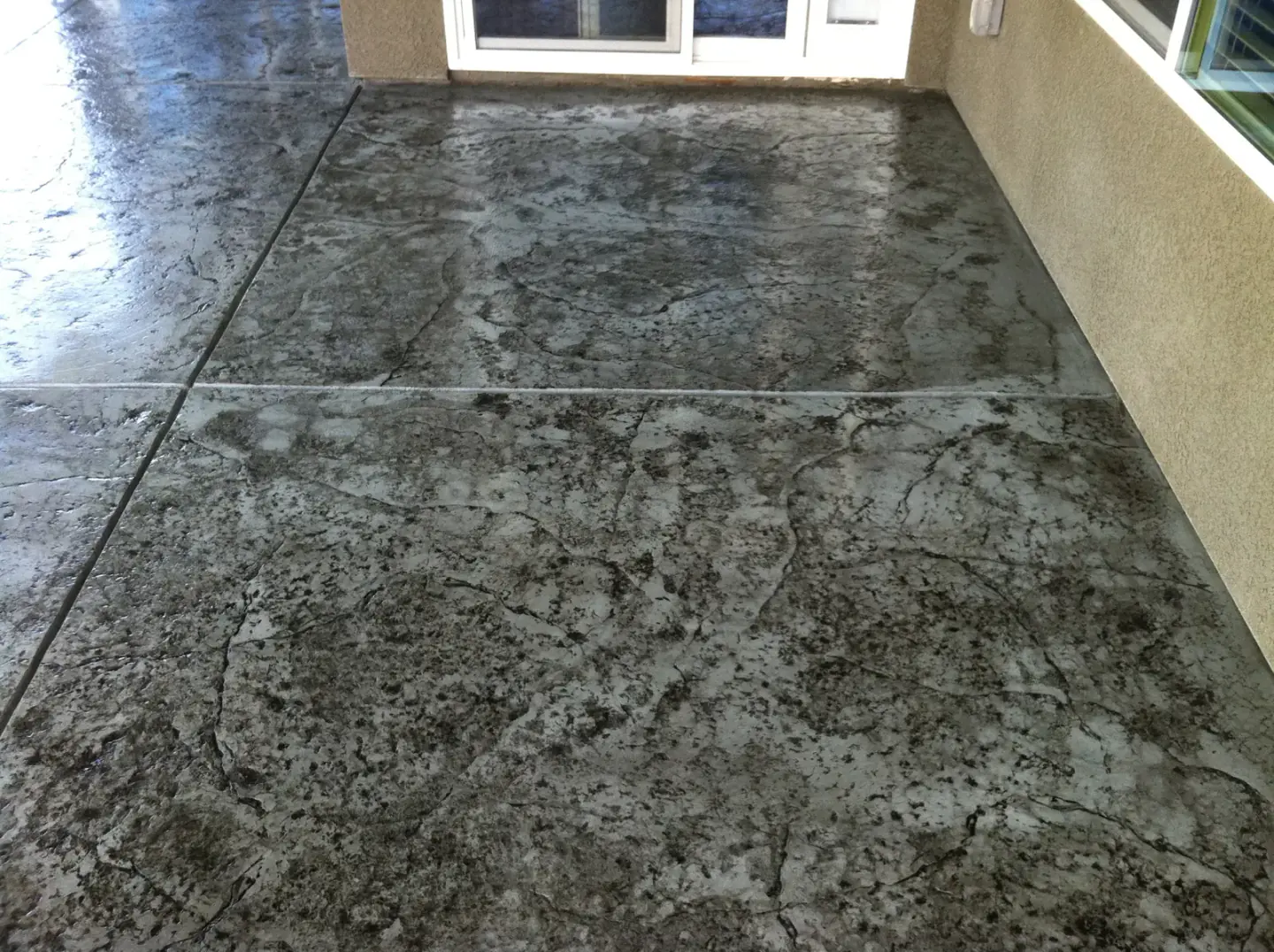
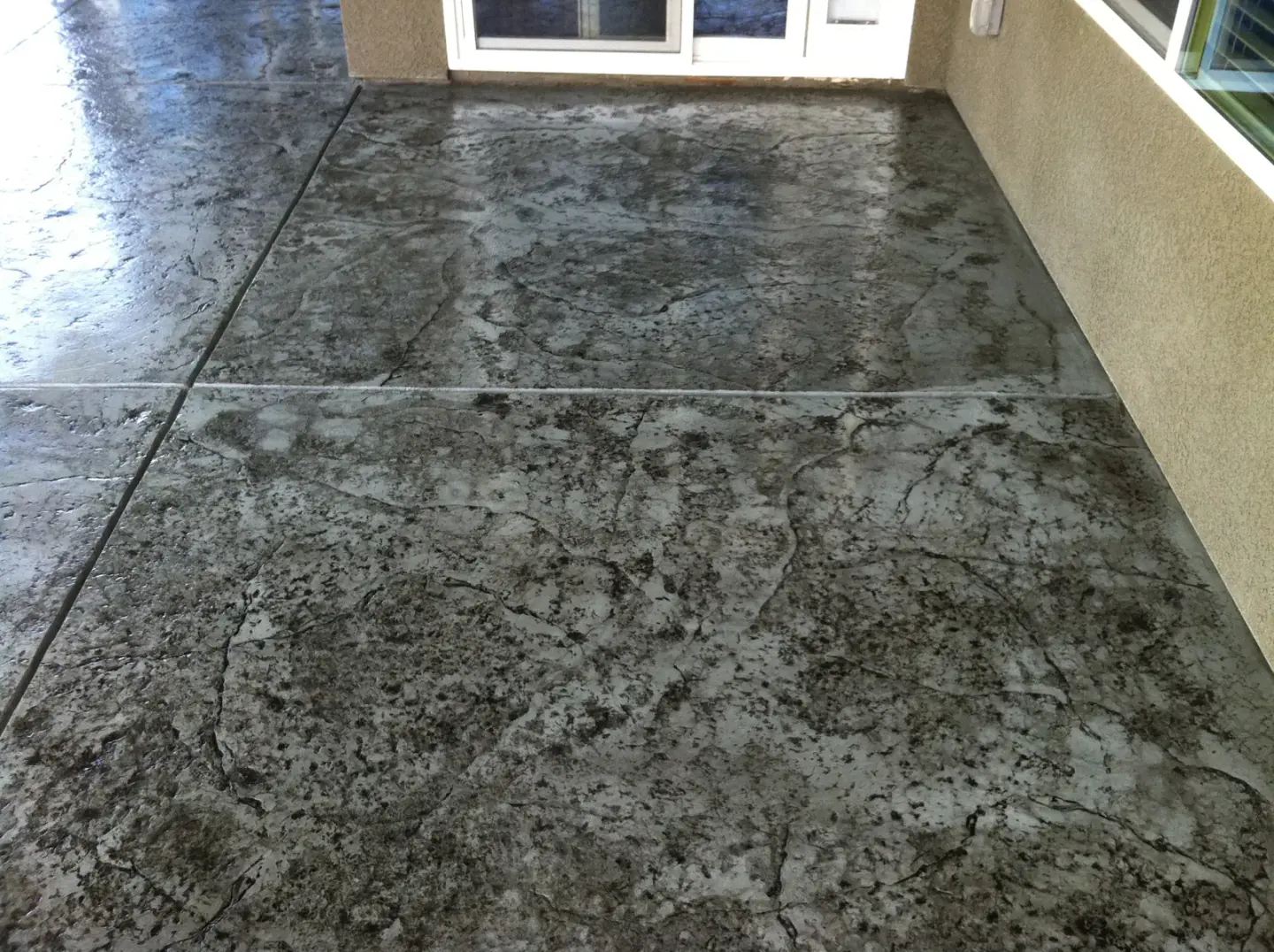
Stamped concrete or pavers: the short answer
For a covered patio, a walkway or a driveway, stamped concrete is the better choice in the Central Valley. For a pool surround, anything over a utility line, and any surface in full sun that you will walk on barefoot, pavers are worth the extra money. Both are trying to give you the look of stone, brick or slate without quarried stone prices, and both do it well. We install both with our own crews, so we have no reason at all to talk you into either one.
The real difference is not appearance at year one, where honestly a good stamp and a good paver field both look excellent. It is what happens at year ten. Stamped concrete fades and needs resealing, and when it cracks the repair is visible. Pavers keep their color almost indefinitely and repair invisibly, but they settle, and their joints are an open invitation to weeds and ants in a valley yard. Pick the failure mode you would rather live with.
For a covered patio, a walkway or a driveway, stamped concrete is the better choice in the Central Valley. For a pool surround, anything over a utility line, and any surface in full sun that you will walk on barefoot, pavers are worth the extra money. Both are trying to give you the look of stone, brick or slate without quarried stone prices, and both do it well. We install both with our own crews, so we have no reason at all to talk you into either one.
Cost per square foot, honestly
As of 2026 in Fresno, Clovis and the surrounding towns, stamped and colored concrete runs about $16 to $24 per square foot installed. Standard concrete pavers run about $16 to $26 per square foot over a properly compacted base, and travertine or premium porcelain runs above that. On paper they overlap, which surprises people who expect stamped concrete to be dramatically cheaper. It used to be, back when paver prices were higher and stamping was less labor intensive, and that reputation has outlived the arithmetic behind it.
Where stamped concrete genuinely wins on cost is at scale and on simple shapes. A large rectangular patio or a straight driveway pours fast, and the price per square foot drops as the area grows. Pavers are priced much more linearly, because every square foot is another unit somebody places by hand. Where pavers win on cost is on complicated geometry: curves, radii, multiple levels and tight inset areas that would take a lot of forming and saw cutting in concrete.
Over twenty years, add resealing for the stamped surface every two to four years, and joint sand refreshes plus occasional re leveling for the pavers. Those two maintenance bills are roughly comparable. Neither material is the cheap one. The cheap option in a valley backyard is a light broom finish concrete patio with a saw cut pattern, at roughly $9 to $14 per square foot, and there is nothing second rate about that surface. It is what we pour more of than anything else, and it outlives a good deal of what people spend more money on.
- Stamped and colored concrete: about $16 to $24 per square foot
- Standard concrete pavers: about $16 to $26 per square foot
- Travertine or porcelain pavers: usually above $26 per square foot
- Large simple areas favor stamped concrete on price
- Curves, levels and tight geometry favor pavers on price
How each one looks at year one and year fifteen
At year one, a well executed stamp is hard to distinguish from stone at conversational distance. The pattern variation, the release color and a good border make it convincing. Pavers look like what they are, which is a manufactured unit laid in a pattern, and plenty of people prefer that honest look. A crisp paver field with a soldier course border reads as deliberate hardscape rather than as an imitation of something else, and on a newer Clovis or Madera house that often suits the architecture better.
At year fifteen the two have diverged. Stamped concrete has faded, especially in a west facing yard that takes the full afternoon in Fresno, and how much it faded depends entirely on whether it was resealed on schedule. A neglected stamped patio goes chalky and washed out and the release color dulls. Pavers hold color far better, because the color goes through the unit rather than sitting on the surface, but by year fifteen the field will have settled somewhere, joint sand will have thinned, and weeds or ants will have found a seam. Both are fixable. The stamped patio needs a reseal and possibly a recolor. The paver field needs a lift, re compaction and fresh polymeric sand.
Repairs, which is the real difference
This is the section that should decide it for most people. A paver repair is genuinely invisible. Lift the units, fix the base or the root or the pipe underneath, reset the same units, sweep in new joint sand, done in a day. Keep a small stock of leftover pavers in the side yard and you can even replace a stained or chipped unit twenty years later with a perfect match.
A stamped concrete repair is visible, always. Matching the color, the pattern registration and the release on an old slab is not realistic, and anyone who promises otherwise has not tried it on a fifteen year old patio. What we do instead is design for it: saw cut joints placed where a section could be replaced cleanly, borders and bands that give a natural line to break at, and proper reinforcement and joint spacing so it does not come to that. If your yard has utilities under the surface or mature trees pushing at it, that consideration alone can be the argument for pavers.
- Pavers repair invisibly and can be lifted and reset
- Stamped concrete repairs are always visible, so plan joints where a section could be replaced
- Keep spare pavers from the original pallet for future matching
- Over utility lines or near aggressive roots, pavers are the safer choice
Want your yard priced?
Free estimate, we walk it with you.
Sealing, resealing and what maintenance actually looks like
Stamped concrete needs sealer, and sealer is not optional if you want the color to survive a valley summer. Plan on resealing every two to four years, more often in full sun, less often under a cover. A reseal on a typical patio is not expensive and it restores most of the depth of color, so the maintenance is real but manageable. What you should know going in is that a sealed stamped surface is slicker when wet than a broom finish, which is why a slip additive goes into the sealer on any surface near water or on a slope.
Paver maintenance is joints and the occasional reset. Polymeric sand swept in and activated correctly holds for years. Every so often you top it up, and eventually a section settles enough to want lifting and re compacting. Neither material is maintenance free, and anyone selling you either one as zero maintenance is skipping past the part you will be living with. We would rather you hear the maintenance schedule at the estimate than discover it for yourself in year four.
Heat underfoot in a Fresno July
On a 105 degree afternoon, a dark stamped patio in full sun is brutal, and a dark paver field is nearly as bad. Color drives this far more than material does. Stamped concrete tends to run hotter than pavers of the same tone for two reasons: stamped work is usually specified in richer, darker earth tones because that is what sells the stone look, and a sealed surface reflects less than a matte unit. A light sand or bone colored paver or a light broom finish concrete is the coolest thing you can put underfoot out there.
If the area is under a cover, none of this matters much and stamped concrete is an easy yes. If it is a pool surround or an open patio people cross barefoot, either pick a light color in whichever material you prefer, or plan the shade before you pick the surface. Barefoot comfort decides more of these projects than looks do, and it is the thing homeowners regret getting wrong.
What we would install, by use case
Covered patio, California room floor or anything under shade: stamped concrete. The heat argument disappears, the sealer lasts far longer out of the sun, and you get the better price per square foot on a simple rectangle. Driveway: stamped concrete, on a reinforced five inch slab, with a slip additive in the sealer at the approach. A stamped apron at the street end over a broom finish body is the version that costs least and still makes the impression you wanted.
Pool surround: pavers, or a light broom finish or exposed aggregate concrete deck, and not a dark stamp. Walkways and side yards: stamped or decorative concrete, because they are narrow, simple and cheap to pour. Areas over utilities, under mature trees, or with curves and multiple levels: pavers. Side yards in older Fresno neighborhoods are the one place we will happily pour plain broom finish and not apologize for it, because nobody stands there admiring it and everything in a side yard has to stay walkable when it is wet.
Plenty of the best yards we build use both. A stamped concrete field with a paver band at the border, or a paver path running through a broom finish deck, costs less than an all paver yard and looks more designed than an all concrete one. We will tell you where pavers are the better answer even though the concrete is our own trade.
- Covered patio: stamped concrete
- Driveway: stamped concrete on a reinforced slab, slip additive in the sealer
- Pool surround: pavers, or light broom finish or exposed aggregate concrete
- Over utilities, near big roots, or on curves and levels: pavers
- Walkways and side yards: decorative or stamped concrete
Questions we get about this
The follow ups this subject raises once somebody starts pricing it for real.
Is stamped concrete cheaper than pavers?
Usually a little, and less than people expect. In 2026 stamped runs about $16 to $24 per square foot around Fresno and Clovis against about $16 to $26 for standard pavers. Stamped concrete pulls further ahead on large simple areas because a big rectangle pours fast. Pavers close the gap or win on curves, multiple levels and tight inset shapes that need a lot of forming and saw cutting.
Does stamped concrete crack more than pavers?
Stamped concrete cracks where any concrete would, which is why compaction, reinforcement and control joint placement matter so much. Pavers do not crack, they settle, and settling shows as an uneven field rather than a line. The practical difference is the repair: a paver repair disappears, a stamped concrete repair is always visible. Plan the saw cut joints so a section could be replaced cleanly if it ever needs to be.
How often does stamped concrete need resealing in the valley?
Every two to four years in full sun, longer under a patio cover. Fresno afternoons are hard on sealer and hard on color, and a stamped patio that has gone four or five years without a coat looks chalky and washed out. The reseal is inexpensive relative to the original pour and it restores most of the depth of color, so it is worth putting on a calendar.
Salas Outdoor
Written by the crew that does the work. Family owned since 1980, backyard remodeling and concrete across Fresno, Clovis and the Central Valley.